What Actually Makes a Nano-Hydroxyapatite Toothpaste Effective? It's Not Just Concentration
Walk through the nano-hydroxyapatite toothpaste category, and you will notice a pattern: brands competing on percentage. 10%. 15%. Some claiming higher is always better. It is a compelling marketing angle, but it sounds like better, but the clinical research tells a more nuanced story. Concentration matters, but it is not the primary driver of effectiveness. Particle shape, particle size, formulation quality, ingredient compatibility, and the source of the n-HA itself all influence how the ingredient actually performs on your enamel. Understanding these variables is what separates a well-designed formula from an expensive one.

What the Research Actually Says About Concentration
The most commonly cited concentration benchmark in the n-HA space is 10%, drawn from studies on micro-scale hydroxyapatite that many brands use to justify higher percentages. But there are two critical caveats almost never mentioned when this benchmark is referenced in product marketing.
First, the particles used in that study were micro-scale rather than true nanoscale, larger, off-the-shelf hydroxyapatite powder described as "nano" but not engineered to the precise particle dimensions that determine enamel integration. Second, the concentration was measured by weight, not volume, which is how most toothpaste manufacturers measure, making direct comparisons between that study and product labeling inherently unreliable.
More critically, a randomized controlled trial published in National Library of Medicine directly compared 10% and 15% nano-HAP toothpastes and found that increasing concentration from 10% to 15% did not produce a statistically significant difference in dentinal tubule occlusion or mineral layer deposition effectiveness. Both concentrations performed comparably. The headline finding, that 15% was better than 10%, was a non-significant trend, not a clinically meaningful difference.
The practical implication: the jump from 10% to 15% that many brands use to justify premium pricing does not correspond to a meaningful performance difference in the clinical data. What determines performance is not primarily concentration, it is the quality and morphology of the particles.
Why Particle Shape Is the Critical Variable
Not all nano-hydroxyapatite is the same shape. The two main morphologies used in oral care are rod-shaped and needle-shaped particles. This distinction matters for both effectiveness and safety, and it is the detail most brands never disclose.
Rod-shaped particles in the 20-80nm range closely mirror the natural crystalline architecture of human enamel rods. This structural match is what allows them to integrate with the tooth surface rather than simply coating it. It is established that n-HA is a credible fluoride alternative used for rod-shaped particles specifically, and the majority of positive clinical evidence across the n-HA research body has been generated using rod-shaped morphology.
On the safety side, a safety opinion drawing a clear distinction between morphologies: needle-shaped nano-hydroxyapatite was identified as a safety concern due to potential toxic effects, while rod-shaped and other non-needle morphologies were not subject to the same restriction. A product can list "nano-hydroxyapatite" on its label without specifying shape, which means the percentage tells you almost nothing about safety or efficacy without knowing the morphology.
The Source of the n-HA Matters as Much as the Percentage
The quality and consistency of nano-hydroxyapatite vary significantly by manufacturer and production process. Not all n-HA sources produce particles of uniform shape, size, and purity, and these variables directly affect how the ingredient performs in a formula.
nanoXIM, produced in Europe and approved by the SCCS, is one of the most rigorously characterized n-HA sources available. Research on nanoXIM specifically has shown it to be effective for remineralization, sensitivity reduction, and whitening at concentrations significantly lower than the 10% benchmark that the misapplied Chinese study established as a marketing standard. The particle quality and consistency of a pharmaceutical-grade n-HA source like nanoXIM deliver more predictable and reliable enamel interaction than a higher percentage of a lower-quality, less-characterized source.
Formulation Quality: Why the Surrounding Ingredients Determine Performance

Even pharmaceutical-grade n-HA underperforms in a poorly designed formula. Several formulation factors directly affect how effectively n-HA reaches and interacts with enamel:
pH balance
Hydroxyapatite dissolves in acidic conditions. A toothpaste with a low or unstable pH can partially deactivate n-HA before it reaches the tooth surface. An alkaline or neutral pH formula preserves n-HA activity and supports the natural remineralization environment inside the mouth.
Ingredient compatibility
Some toothpaste ingredients compete with or deactivate n-HA. SLS, for example, denatures the mucosal protein layer that helps n-HA particles adhere to the tooth surface. Certain abrasives can physically interfere with particle distribution. A well-formulated n-HA toothpaste chooses supporting ingredients that complement rather than counteract the active mineral.
Dispersion and stability
n-HA particles must remain evenly dispersed throughout the formula from manufacture to use. Particle agglomeration, where particles clump together, reduces effective surface area and limits enamel contact. Proper formulation chemistry maintains consistent particle distribution across the product's shelf life.
Supporting active ingredients
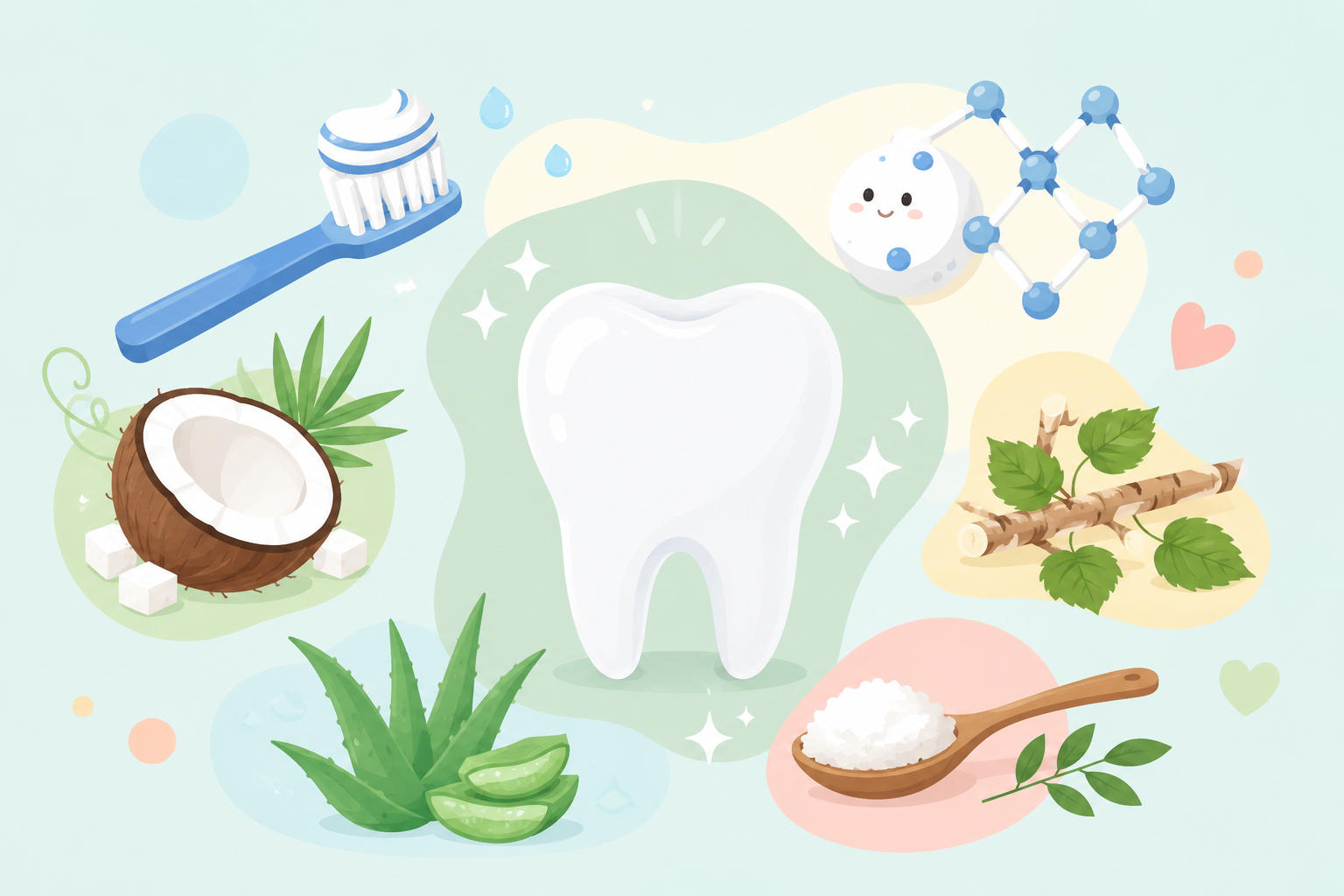
The ingredients that surround n-HA in the formula determine the oral environment it operates in. Xylitol selectively reduces cariogenic bacteria without disrupting beneficial oral flora. Coconut oil reduces the bacterial film that competes with n-HA for enamel surface contact. Aloe vera supports gingival health, reducing inflammation that can interfere with enamel recovery. A formula where every ingredient supports the environment, n-HA needs to perform outperforms a higher-concentration formula where ingredients work against each other.
Contact Time and Consistency: The Variables That Matter Most Day to Day

Even the best-formulated n-HA toothpaste cannot outperform an inconsistent routine. The remineralization benefit of nano-hydroxyapatite is cumulative, mineral density rebuilds gradually over weeks and months of twice-daily use, not from a single application of a high-concentration product.
Contact time within each brushing session also matters. Brushing for a full two minutes allows n-HA particles adequate time to interact with enamel surfaces and begin mineral deposition. Rinsing immediately after brushing shortens this contact window. Many dental professionals suggest either not rinsing at all after brushing or using only a small amount of water to spit, preserving the active ingredient layer on enamel surfaces after the brush is down.
The research consistently supports this principle: a well-formulated nanoXIM-based toothpaste used correctly twice daily, even at 5% concentration, delivers better long-term enamel outcomes than a higher percentage of lower-quality particles used inconsistently or incorrectly.
What to Actually Look For When Choosing an n-HA Toothpaste
Given everything above, the percentage on the label is the least informative number to evaluate. The questions that actually predict performance are:
-
Is the particle shape specified? Rod-shaped in the 20-80nm range is the morphology with the strongest clinical evidence and the most favorable regulatory safety profile. If a brand does not specify shape, ask why.
-
What is the source of the n-HA? nanoXIM is the only nano-hydroxyapatite source approved for use in Europe, backed by SCCS approval and verified by third-party testing. Generic or unspecified sources vary more widely in particle quality, size distribution, and purity, and no amount of higher percentage compensates for that variability.
-
Is the formula SLS-free? SLS disrupts the mucosal protein layer that supports n-HA adhesion to the tooth surface. An SLS-free formula preserves the conditions n-HA needs to work.
-
What supporting ingredients are included? Xylitol, coconut oil, and aloe vera create the oral environment where n-HA performs optimally. High-abrasivity whitening agents undermine it.
-
Is the pH balanced? An alkaline or neutral pH preserves n-HA activity. An acidic formula partially deactivates the ingredient before it reaches your enamel.
SAINT Mint Toothpaste is formulated around every one of these variables: rod-shaped nanoXIM n-HA in the 20-80nm range, SLS-free, pH-balanced, with xylitol, coconut oil, and aloe vera as the supporting active ingredients. Available in both fluoride and fluoride-free versions.
FAQs About Nano-Hydroxyapatite Concentration and Effectiveness
1. Does a higher nano-hydroxyapatite percentage mean a better toothpaste?
Not necessarily. A randomized controlled trial comparing 10% and 15% nano-HAP found no statistically significant difference in tubule occlusion or mineral layer deposition between the two concentrations. Particle shape, particle source quality, formulation pH, and supporting ingredients are stronger predictors of performance than the percentage alone.
2. What is the optimal concentration of nano-hydroxyapatite in toothpaste?
The research does not support a single universal optimal percentage. Clinical trials on generic micro-scale particles established 10-15% as benchmarks, but those particles are not comparable to pharmaceutical-grade nanoXIM. Research on nanoXIM specifically has demonstrated effective remineralization, sensitivity reduction, and whitening at concentrations well below those benchmarks, because the particle quality, size precision, and enamel affinity of nanoXIM are fundamentally superior. SAINT uses 5% nanoXIM, a concentration that performs effectively precisely because of what the n-HA is, not how much of it is present.
3. Why does particle shape matter for nano-hydroxyapatite?
Rod-shaped particles in the 20-80nm range mirror the natural crystalline architecture of human enamel, allowing them to integrate with the tooth surface effectively. The European Scientific Committee on Consumer Safety identified needle-shaped nano-hydroxyapatite as a safety concern and recommended against its use in cosmetic products, while rod-shaped particles were not subject to the same restriction. A product that does not specify morphology may be using the less-studied or less-safe form.
4. What is nanoXIM and why does the source matter?
nanoXIM is the only nano-hydroxyapatite source approved for use in Europe, produced to pharmaceutical-grade standards with consistent particle shape, size, and purity. When a brand sources exclusively from nanoXIM and backs its formula with verified third-party lab testing, it is operating at a different quality level than generic or unspecified sources, where the same listed percentage can deliver very different real-world results depending on particle characteristics. That quality difference shows up in performance: formulas built on nanoXIM have demonstrated strong outcomes in both remineralization and tubule occlusion in comparative testing.
5. Does SLS affect how nano-hydroxyapatite works?
Yes. SLS denatures the mucosal protein layer inside the mouth, the same layer that helps n-HA particles adhere to and interact with enamel surfaces. An SLS-free formula preserves the conditions n-HA needs to work optimally. This is one reason SLS-free formulation is a meaningful quality indicator for any n-HA toothpaste, not just a preference for sensitive users.
6. Is daily consistency more important than high concentration?
Yes, based on the cumulative nature of remineralization. Enamel mineral density rebuilds gradually over weeks and months of twice-daily use. A well-formulated n-HA toothpaste using pharmaceutical-grade nanoXIM at 5%, used consistently twice daily, delivers better long-term outcomes than a higher-concentration product using lower-quality particles used irregularly. Contact time within each brushing session also matters, brushing for a full two minutes and avoiding immediate rinsing preserves the active mineral layer on enamel after brushing.