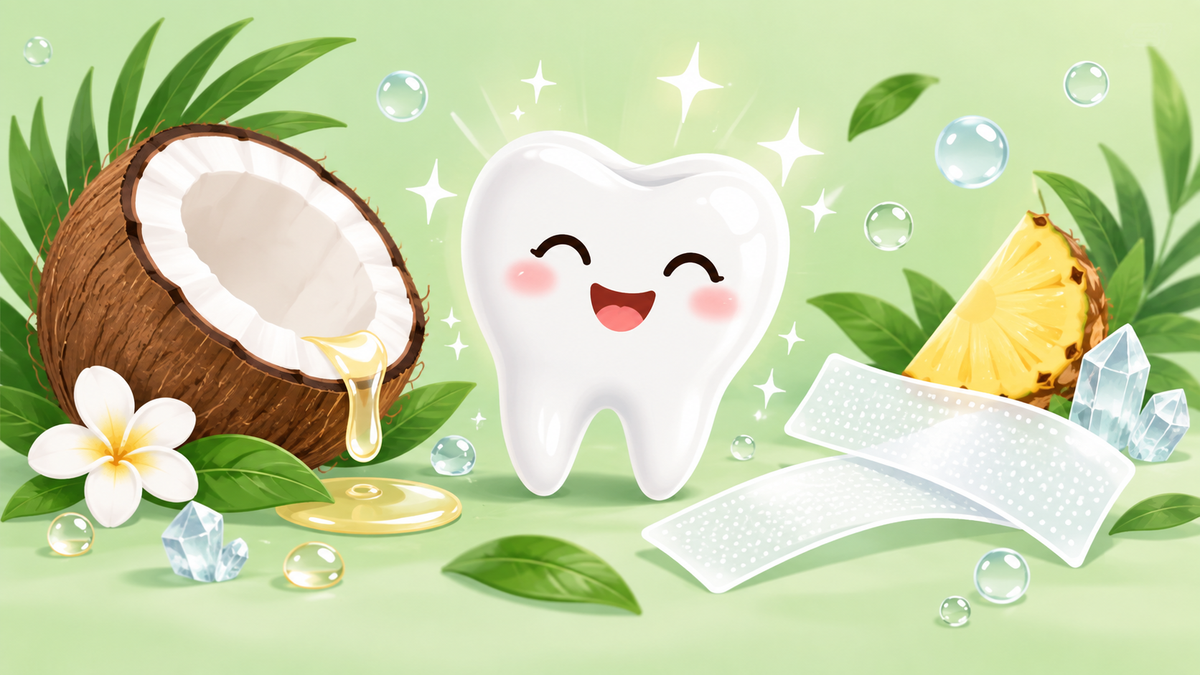
Coconut Oil in Whitening Strips: Comfort Ingredient or Active Whitener?
Coconut oil shows up in everything from toothpaste to oil-pulling routines. So when you see coconut oil in whitening strips, it is reasonable to wonder if the oil itself is actually whitening your teeth.
The answer needs some context.
Research has explored coconut oil for plaque, bacteria, and general oral hygiene. But that is different from showing that coconut oil can chemically bleach deeper tooth discoloration. A systematic review of coconut oil pulling found some promising oral-hygiene results, but the researchers also described the evidence as limited and called for stronger clinical trials.
That does not make coconut oil useless in whitening strips. It simply means its role should be described accurately.
In a complete whitening formula, coconut oil can sit alongside ingredients with different jobs. Hydrogen peroxide provides the main bleaching action. Bromelain can support surface-stain removal, while nano-hydroxyapatite is used for enamel-focused mineral care.
That full-formula approach is more useful than turning coconut oil into another whitening miracle ingredient.

TL;DR
Coconut oil can be a useful supporting ingredient in whitening strips, but it is not the ingredient responsible for bleaching deeper tooth discoloration. Hydrogen peroxide handles the main chemical whitening action. Coconut oil makes more sense as part of a balanced formula alongside bromelain for surface stains and nano-hydroxyapatite for enamel support. When comparing whitening strips, look at the complete formula instead of expecting one ingredient to do everything.
Does Coconut Oil in Whitening Strips Actually Whiten Teeth?
Coconut oil may support the overall oral-care formula, but current evidence does not show that coconut oil alone chemically bleaches deeper tooth discoloration. Most clinical research on coconut oil has focused on plaque, bacterial counts, and oral hygiene rather than the type of tooth-color change produced by peroxide bleaching.
One of the most useful reviews looked at coconut oil pulling rather than whitening strips. It included four randomized controlled trials with 182 participants. The studies lasted between seven and 14 days and reported possible improvements in plaque scores and salivary bacterial counts. However, the review found substantial limitations in the evidence and a high risk of bias. You can review the systematic review on coconut oil pulling and oral health here.
That distinction matters.
A tooth can look cleaner or brighter because surface buildup has been reduced. That is not necessarily the same thing as bleaching the colored compounds responsible for deeper discoloration.
Peroxide-based whitening works through a different process. A scientific review of tooth-whitening mechanisms describes whitening as involving diffusion of the bleaching material and interaction with stain molecules within dental tissues.
So if a whitening strip contains both coconut oil and hydrogen peroxide, it does not make sense to give both ingredients the same job.
Hydrogen peroxide is the main bleaching active. Coconut oil belongs on the supporting side of the formula.
What Can Coconut Oil in Whitening Strips Realistically Do?
The most useful way to think about coconut oil is as a supportive ingredient, not a stand-alone whitener.
Research on coconut oil pulling suggests it may have a place in oral hygiene, but those findings should not be stretched into claims that coconut oil can bleach teeth. The systematic review found limited evidence of benefits involving plaque and bacteria, while emphasizing the need for higher-quality research.
That leaves plenty of room for coconut oil to make sense in a thoughtfully designed formula.
A whitening strip does not need every ingredient to perform chemical bleaching. Supporting ingredients can be chosen to complement the whitening active and contribute to the overall formulation.
This is also why it helps to move away from the idea of a single "hero ingredient."
If the formula already contains an established bleaching ingredient, coconut oil does not need to replace it. It can simply be part of the larger system.
That same idea applies across oral care. We explain it in our guide to xylitol in toothpaste and floss. A useful ingredient can support a formula without needing to be the ingredient responsible for its main effect.
What Actually Bleaches Deeper Tooth Discoloration?

Hydrogen peroxide provides the main bleaching action in peroxide-based whitening strips. It works differently from ingredients that mainly affect surface buildup because peroxide can diffuse through dental tissues and interact with the colored compounds involved in tooth discoloration. The whitening result depends on more than concentration alone, including contact time and treatment protocol.
The American Dental Association identifies hydrogen peroxide and carbamide peroxide as common bleaching ingredients used to whiten teeth. The ADA also separates bleaching from products that mainly remove surface stains.
A review of tooth-whitening mechanisms found that peroxide whitening involves the movement of bleaching agents through the tooth and their interaction with stain molecules and dental structures.
Clinical research supports that bleaching role.
A 2026 randomized controlled trial enrolled 70 adults with extrinsic tooth discoloration. Participants using strips with 3% hydrogen peroxide had better whitening results than the placebo group. Five adverse events occurred across the study, with no significant difference between the treatment and placebo groups, and no serious adverse events were reported. You can read the 3% hydrogen peroxide whitening-strip trial here.
That study does not mean every peroxide product produces identical results. It does show why hydrogen peroxide has a much stronger basis as the active whitener than coconut oil.
This is also why "contains peroxide" should not automatically be interpreted as "harsh."
The better question is how much peroxide is being used, how long the teeth are exposed to it, how often the treatment is repeated, and how the complete product is designed.
We explore that distinction further in how much peroxide is too much for teeth whitening and our guide to whether peroxide whitening can be enamel-safe.
How Do Bromelain and Nano-Hydroxyapatite Support Whitening?
Bromelain and nano-hydroxyapatite have supporting roles that are different from peroxide bleaching. Bromelain has been studied in enzyme-based dentifrices for removing extrinsic stains, while nano-hydroxyapatite has stronger research around enamel mineral support. Neither ingredient needs to be described as a replacement for hydrogen peroxide.
Bromelain is an enzyme derived from pineapple.
A randomized clinical study evaluated an enzymatic whitening toothpaste containing papain and bromelain for extrinsic stain removal. Researchers reported reductions in external stain scores with the enzyme-containing toothpaste. Another clinical trial comparing enzymatic and abrasive whitening toothpastes also found papain- and bromelain-containing toothpaste effective for extrinsic stain removal.
There is an important limitation here. That research tested dentifrices, not whitening strips. It supports bromelain's potential role in addressing external stains, but it should not be used to claim that every bromelain-containing strip will produce the same result.
That is exactly the type of distinction that keeps ingredient claims useful.
Nano-hydroxyapatite has a different job.
A 2024 systematic review and meta-analysis evaluated nano-hydroxyapatite for white spot lesions. Fourteen studies met the inclusion criteria, with 12 entering the meta-analysis. The researchers found promising results for enamel remineralization measures, but they did not find a significant improvement in color within the white spot lesions.
That finding helps explain why enamel support and bleaching should not be treated as the same goal.
Nano-hydroxyapatite can support the enamel surface without needing to replace peroxide. You can read more about the mineral-care side in our guide to how nano-hydroxyapatite supports enamel remineralization.
We also break down the difference between hydroxyapatite and peroxide whitening if you want a closer look at brightness, remineralization, and true bleaching.
Why Coconut Oil in Whitening Strips Works Best as Part of a Complete Formula
A whitening strip makes more sense when you stop asking every ingredient to whiten teeth in exactly the same way.
The current SAINT Whitening Strips formula lists coconut oil, deionized water, cellulose gum, carbomer, nano-hydroxyapatite, bromelain, hydrogen peroxide, white turmeric, Dead Sea salt, and xylitol. SAINT's current directions call for placing the strips on dry teeth, leaving them in place for 30 minutes, then removing them and rinsing.
Each part of that formula should be understood according to its role.
| Ingredient | Role in the Formula |
|---|---|
| Hydrogen peroxide | Provides the main chemical bleaching action for tooth discoloration. |
| Coconut oil | Functions as a complementary ingredient within the overall whitening formula. |
| Bromelain | Enzyme with research supporting a role in external stain removal. |
| Nano-hydroxyapatite | Enamel-focused ingredient with research around remineralization and mineral support. |
| White turmeric | Complementary botanical ingredient, rather than a replacement for peroxide bleaching. |
| Xylitol | Supporting oral-care ingredient rather than a bleaching active. |
| Dead Sea salt | Part of the supporting formula. |
| Deionized water | Part of the formula base. |
| Cellulose gum | Helps form the strip's overall gel system. |
| Carbomer | Helps provide structure and consistency within the formula. |
Hydrogen peroxide is the ingredient with the clearest bleaching role. Bromelain sits closer to the surface-stain side of the conversation. Nano-hydroxyapatite belongs in the enamel-support discussion.
Coconut oil does not need to compete with any of them.
The same goes for white turmeric, Dead Sea salt, and xylitol. A complete formula can contain several complementary ingredients without pretending they all perform the same chemical whitening process.
That is a more useful way to read an ingredient label.
Instead of asking, "Which one ingredient makes this product work?" ask, "What job does each ingredient perform, and does the complete formula make sense?"
Can Peroxide Whitening Still Be Gentle?

Yes. Peroxide is not automatically harsh simply because it is an active bleaching ingredient. Whitening experience can be affected by peroxide concentration, treatment duration, frequency, gum exposure, product design, and individual sensitivity. Evidence suggests that lower peroxide concentrations can reduce sensitivity compared with higher concentrations under certain clinical conditions.
The ADA notes that temporary tooth sensitivity is a common side effect of bleaching. It also lists peroxide concentration and contact time among the factors that can influence sensitivity.
A systematic review and meta-analysis comparing high-concentration hydrogen peroxide with lower concentrations found greater tooth sensitivity with the higher-concentration treatments.
Another systematic review and network meta-analysis of at-home bleaching treatments found that some higher peroxide and carbamide peroxide concentrations were associated with a greater risk or intensity of sensitivity than lower-concentration options. The authors also noted that most included studies had a high risk of bias and that the quality of evidence was low, so the findings should be interpreted carefully.
This is why concentration cannot be separated from the rest of the treatment.
Contact time matters too.
Wearing whitening strips longer than instructed does not automatically make the formula better. It changes how long the bleaching agent stays in contact with the teeth and gums.
SAINT's current strip directions specify a 30-minute application. Following that wear time is part of using the product as it was designed.
If sensitivity is one of your main concerns, our guide to gentler whitening strips and complete formulas explains why concentration, fit, wear time, and supporting ingredients all deserve attention.
The goal should not be to fear an effective active ingredient.
It should be to use that ingredient thoughtfully.
How Should You Evaluate Coconut Oil Whitening Strips?
Start by finding out what is actually responsible for changing tooth color.
If a product makes strong whitening promises around coconut oil but does not explain how deeper discoloration is being bleached, that deserves a closer look. Current coconut-oil evidence focuses much more on oral hygiene than peroxide-like chemical bleaching.
Next, look at the complete formula.
Does it contain a recognized whitening active? Are surface-stain ingredients described as surface-stain ingredients? Are enamel-supportive ingredients presented as support rather than exaggerated as bleaching agents?
Then check the directions.
Whitening is not only about ingredients. Concentration, contact time, treatment frequency, and correct placement can all affect the experience. The ADA's review of whitening safety makes that especially clear when discussing sensitivity.
Finally, avoid assuming that "natural" means effective or that "peroxide" means harsh.
Those labels tell you very little about how a complete product performs.
A better formula gives each ingredient a clear job.
Conclusion
Coconut oil can make sense in whitening strips without needing to be the ingredient that bleaches your teeth.
Current evidence does not put coconut oil in the same whitening category as hydrogen peroxide. Peroxide provides the deeper chemical bleaching action. Bromelain can complement that action by supporting surface-stain removal, while nano-hydroxyapatite has a different role centered on the enamel surface.
That is why the complete formula matters more than one headline ingredient.
When comparing whitening strips, look at the active whitener, supporting ingredients, wear time, directions, and how clearly the brand explains what each ingredient does.
If you want a whitening formula that combines peroxide with coconut oil, bromelain, nano-hydroxyapatite, white turmeric, Dead Sea salt, and xylitol, you can explore the complete formula behind SAINT Whitening Strips.
Frequently Asked Questions
1. Does coconut oil actually whiten teeth?
Coconut oil has been studied for oral hygiene, plaque, and bacterial measures, but there is not strong clinical evidence showing that coconut oil alone produces peroxide-like bleaching of deeper tooth discoloration. A systematic review found possible oral-health benefits from coconut oil pulling, but the evidence was limited and at high risk of bias.
2. What does coconut oil do in whitening strips?
Coconut oil is best viewed as a complementary ingredient within the overall whitening formula rather than the primary bleaching active. In a formula such as SAINT Whitening Strips, hydrogen peroxide handles the main bleaching role while coconut oil appears alongside other supporting ingredients.
3. Is coconut oil a replacement for hydrogen peroxide?
No. Current research does not show that coconut oil performs the same chemical bleaching action as hydrogen peroxide. Peroxide-based whitening involves diffusion and interactions with colored compounds within dental tissues, while coconut-oil studies have focused mainly on oral hygiene.
4. Are peroxide whitening strips bad for enamel?
Peroxide whitening is not automatically damaging simply because peroxide is present. Concentration, exposure time, treatment frequency, individual oral health, and correct use all matter. The ADA also notes that temporary sensitivity can occur with bleaching and can be influenced by peroxide concentration and contact time.
5. Why does SAINT combine coconut oil with peroxide, bromelain, and nano-hydroxyapatite?
The ingredients serve different purposes within the complete formula. Hydrogen peroxide provides the primary bleaching action, bromelain has research around external stain removal, and nano-hydroxyapatite has research supporting enamel remineralization. Coconut oil is better understood as part of the supporting formula rather than as a replacement for those functions.