Can Whitening Strips Be Gentle? What to Look for in a Better Formula
Most people shopping for whitening strips assume they have to make a choice. They can use something strong enough to work and accept the sensitivity, or choose a gentler product and settle for weaker results.
But can whitening strips be gentle without giving up effective whitening? Research suggests the answer is more nuanced than simply avoiding peroxide.
Hydrogen peroxide is one of the main bleaching ingredients used in teeth whitening. It works differently from ingredients that only polish away surface stains. The American Dental Association explains that peroxide can move through dental hard tissues and help break down the colored compounds involved in tooth discoloration.
That does not mean every peroxide formula will feel the same.
Concentration, treatment time, frequency, strip placement, and your starting tooth condition can all affect the experience. The supporting ingredients around the whitening active can matter too.
That is why a better question is not simply, "Does this contain peroxide?"
It is, "How was the complete whitening system designed?"

TL;DR
Whitening strips can be gentle and still whiten effectively. What matters is not simply whether a formula contains peroxide. Peroxide concentration, contact time, treatment frequency, strip fit, gum exposure, your enamel condition, and the rest of the formula all matter. Look for a thoughtfully designed whitening system with clear directions, evidence-backed ingredients, and a balanced approach instead of relying on labels like "peroxide-free."
Can Whitening Strips Really Be Gentle?
Yes. Whitening strips can provide effective whitening with a gentler experience when peroxide concentration, treatment time, frequency, placement, and the rest of the formula are carefully balanced. Gentleness is not determined by one ingredient alone. The full treatment protocol matters.
A useful example comes from a 2026 randomized controlled trial of whitening strips containing 3% hydrogen peroxide. Researchers found significant whitening of extrinsic tooth discoloration. The treatment was also well tolerated, with adverse events statistically comparable to the placebo group.
That does not mean every person will respond exactly the same way. Tooth sensitivity can vary based on your teeth, gums, previous dental work, and whitening history.
It does show why peroxide should not automatically be treated as the problem.
A broader systematic review of whitening strips also found that strips can produce meaningful color changes. The review reported lower tooth sensitivity risk and intensity with whitening strips compared with dentist-supervised at-home bleaching, although supervised bleaching produced greater color change in the studies analyzed.
The goal should not be to remove every powerful ingredient from a whitening formula. It should be to use effective ingredients thoughtfully.
What Actually Makes Whitening Strips Feel Harsh?

Whitening discomfort is influenced by several factors, including peroxide concentration, how long the whitening agent contacts your teeth, how often you repeat treatment, and how much gel reaches your gums. Existing tooth sensitivity can also affect how whitening feels.
Tooth sensitivity and gum irritation are among the most common side effects reported with whitening products. A 2024 review of over-the-counter bleaching products found that sensitivity and gingival irritation were among the main adverse effects reported across these products.
Concentration matters. A 2020 clinical study comparing hydrogen peroxide concentrations found that lower hydrogen peroxide concentration produced less tooth sensitivity while still providing effective color improvement.
That is an important distinction.
A higher concentration is not automatically a better formula. Faster whitening can come with trade-offs, especially when active ingredients are used more aggressively.
Contact with your gums matters too. The American Dental Association's whitening review notes that gingival irritation can occur when peroxide-based gels contact gum tissue. It also explains that tooth sensitivity is more common with higher concentrations of whitening actives, although this sensitivity is often temporary.
If you already experience sensitivity, it is worth understanding what may be causing your tooth sensitivity before starting a new whitening routine.
Peroxide-Free Is Not Automatically Gentler
"Peroxide-free" sounds reassuring. But the phrase only tells you which ingredient is missing. It does not tell you how the product whitens, how effective it is, or how the complete formula interacts with your teeth.
Different whitening ingredients work in different ways.
Peroxide chemically changes colored compounds within the tooth. According to the American Dental Association, hydrogen peroxide and carbamide peroxide are widely used bleaching ingredients because they can affect both extrinsic and intrinsic discoloration.
Other ingredients may focus more on surface stains.
For example, bromelain is an enzyme derived from pineapple. A laboratory study comparing over-the-counter whitening agents found that bromelain produced a whitening effect without the enamel surface changes seen in the hydrogen peroxide group. However, hydrogen peroxide caused the greatest overall color change and was able to whiten beyond simple stain removal.
That difference matters.
An ingredient that helps lift coffee or food stains is not necessarily doing the same job as an ingredient that changes deeper tooth color.
This is why "peroxide-free" should not automatically be treated as another way of saying "better."
The same principle applies in the opposite direction. A product containing peroxide is not automatically harsh.
If you want to understand this distinction in more detail, read our guide on whether peroxide is safe for teeth whitening.
How Much Do Concentration, Wear Time, and Frequency Matter?

Peroxide concentration cannot be judged on its own. The amount used, the length of each treatment, and how often treatment is repeated all affect total exposure. A well-designed whitening protocol balances those variables instead of simply using the highest possible concentration.
The recent 3% hydrogen peroxide whitening-strip trial is a good example. Whitening increased over the treatment period even though the study used a relatively low peroxide concentration.
Treatment time matters as well.
A study comparing different daily bleaching times found that longer bleaching exposure produced faster results but higher sensitivity. Although that research involved tray-based bleaching rather than strips, it helps show why exposure time is an important part of any whitening protocol.
That is also why wearing strips longer than directed is not a smart shortcut.
A formula is developed around an intended concentration and contact time. Changing one part changes your overall exposure.
For SAINT Whitening Strips, the current directions specify applying the strips to dry teeth, pressing them securely into place, leaving them on for 30 minutes, then removing them and rinsing with water.
Following the directions is part of the formula.
The Formula Around the Peroxide Matters Too
Peroxide may perform the main bleaching work, but it does not have to work alone.
A thoughtfully designed formula can combine an active whitening ingredient with ingredients chosen for surface cleaning, enamel support, texture, delivery, and the overall treatment experience.
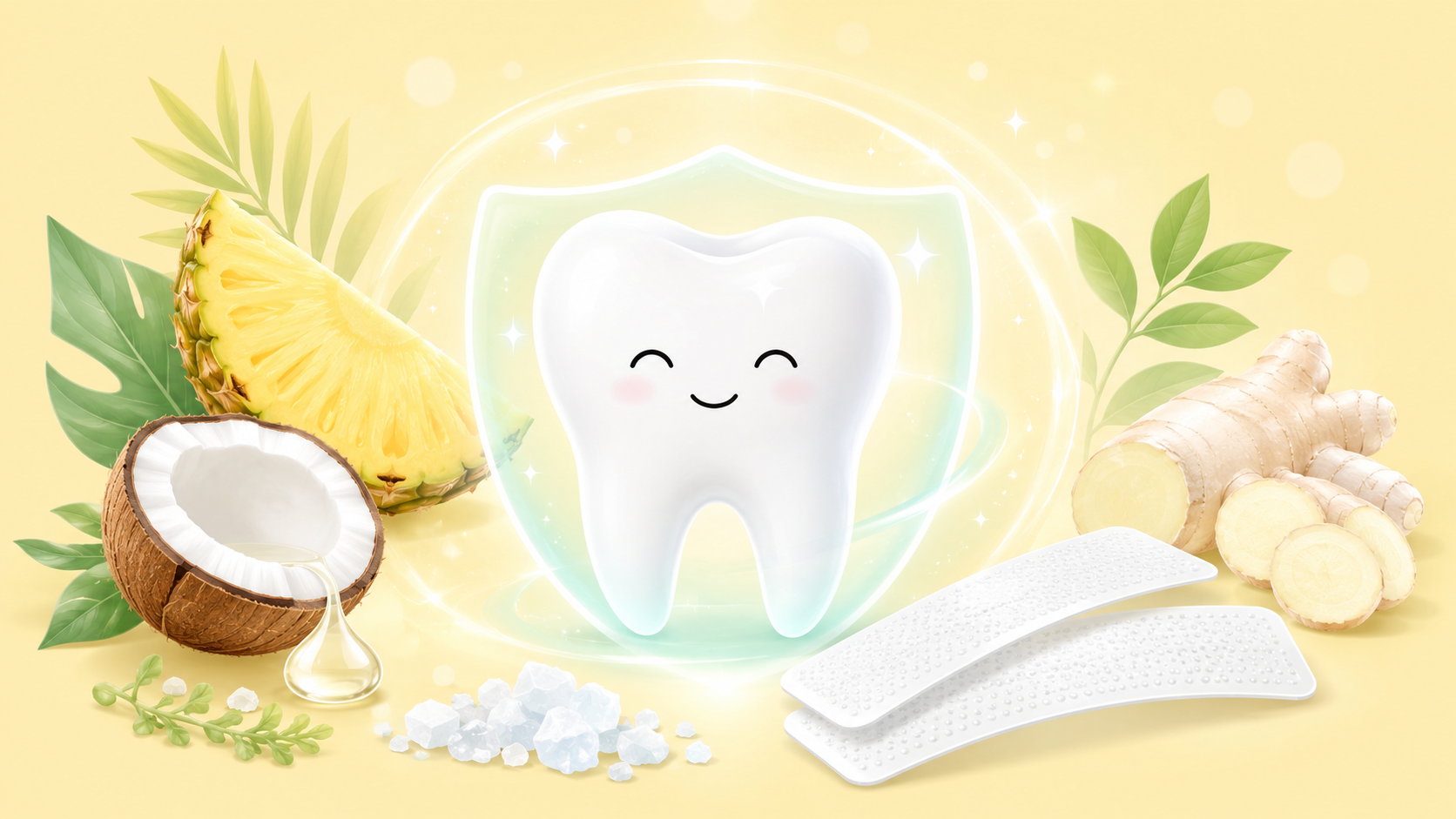
The current SAINT Whitening Strips formula includes:
-
Coconut Oil
-
Deionized Water
-
Cellulose Gum
-
Carbomer
-
Nano-Hydroxyapatite
-
Bromelain
-
Hydrogen Peroxide
-
White Turmeric
-
Dead Sea Salt (Maris Sal)
-
Xylitol
Each ingredient should be understood according to its actual role.
Hydrogen peroxide is the primary bleaching active. It helps break down colored compounds associated with deeper discoloration. This whitening mechanism is well established in dental research and is explained in the ADA's review of tooth whitening.
Nano-hydroxyapatite has a different job. It is a mineral used in oral-care products for enamel and sensitivity support. A systematic review and meta-analysis of nano-hydroxyapatite for dentin hypersensitivity found a significant desensitizing effect in the clinical studies evaluated.
Research has also explored nano-hydroxyapatite for enamel remineralization. One randomized clinical trial comparing nano-hydroxyapatite and fluoride toothpastes found improvement in early white spot lesions in both groups, with the nano-hydroxyapatite group showing stronger improvement on some measures.
You can learn more about how nano-hydroxyapatite supports enamel remineralization.
Bromelain works differently again. Research suggests it can help with surface stain removal, which makes it a useful complement to peroxide rather than a direct replacement for peroxide's deeper bleaching action.
Coconut oil, white turmeric, Dead Sea salt, and xylitol round out the SAINT formula. Rather than treating each ingredient as if it independently bleaches teeth, it is more useful to look at how the complete formula has been put together.
Deionized water, cellulose gum, and carbomer also matter to product formulation. Ingredients like these help create the base, consistency, and delivery system that allow the gel to stay where it is intended.
A longer ingredient list is not automatically better. What matters is whether each ingredient has a clear reason for being there.
Does Whitening-Strip Fit Matter for Gum Comfort?

Yes. A whitening strip should keep the whitening formula mainly against your tooth surface. When whitening gel repeatedly reaches the gums, it can contribute to temporary gum irritation. Good adhesion and careful placement can help control where the formula sits during treatment.
The ADA notes that gum irritation can occur from contact with peroxide whitening gels. With tray systems, poor fit is one factor associated with unwanted gel contact.
The same basic idea applies to strips. Placement matters.
SAINT currently recommends starting with dry teeth so the strips can stay securely in place. The longer strip goes on the upper teeth and the shorter strip on the lower teeth. Users are instructed to press each strip firmly into place, fold the excess behind the teeth, and remove the strips after 30 minutes.
That does not mean everyone will have the same whitening experience. It means proper use gives the product the best chance to work as designed.
How to Read a Whitening-Strip Formula Without Falling for Buzzwords
Whitening labels can make very different products sound almost identical. Instead of choosing based on one headline claim, look at the complete system. Start with the whitening active. Does the brand explain what is actually changing your tooth color?
Next, check whether the directions include a clear treatment time. More whitening time is not automatically better.
Look at treatment frequency too. Whitening should have a defined protocol rather than encouraging uncontrolled overuse.
Then review the supporting ingredients. Ask what each one actually does. An enamel-support ingredient should be described as an enamel-support ingredient. A surface stain ingredient should not be presented as if it performs the same deep bleaching action as peroxide.
Also look for testing and transparency. The current SAINT Whitening Strips product page lists the full ingredient formula and states that its ingredients undergo third-party testing.
Finally, consider your own teeth.
Crowns, veneers, fillings, and other tooth-colored restorations do not whiten like natural teeth. The ADA recommends considering existing restorations and your dental condition before whitening.
If you have untreated decay, cracked teeth, gum problems, or significant sensitivity, talk with a dentist before trying to solve the issue by switching whitening products.
Whitening is also only one part of oral care. A consistent routine still matters, which is why it helps to build a complete oral-care routine around brushing, flossing, enamel care, and responsible whitening.
Conclusion
Gentle whitening is not about removing every powerful ingredient from a formula. It is about using effective ingredients in a thoughtful way.
Peroxide concentration matters, but so do treatment time, frequency, strip fit, gum exposure, and your starting tooth condition. Supporting ingredients can also play useful roles, as long as their benefits are described accurately.
Most importantly, do not judge a whitening product only by whether it says "peroxide-free," "natural," or "extra strength."
Read the full formula. Look at how the whitening system is meant to work. Follow the treatment instructions.
If you are looking for an option that combines active peroxide whitening with nano-hydroxyapatite, bromelain, coconut oil, white turmeric, Dead Sea salt, and xylitol, you can explore the complete formula behind SAINT Whitening Strips.
FAQs About Gentle Whitening Strips
1. Can whitening strips whiten teeth without causing sensitivity?
Yes, some people can use whitening strips with little or no sensitivity, but individual responses vary. Research shows that peroxide concentration and overall exposure can affect sensitivity, which is why choosing a well-designed formula and following its directions matters. A 2026 trial of 3% hydrogen peroxide strips found effective whitening with adverse events statistically comparable to placebo.
2. Are peroxide-free whitening strips safer for sensitive teeth?
Not automatically. "Peroxide-free" only describes what the formula does not contain. Different whitening ingredients work through different mechanisms, and their effectiveness and safety need to be evaluated individually. Research comparing bromelain and other alternatives with hydrogen peroxide found meaningful differences in how deeply the ingredients whitened.
3. Does nano-hydroxyapatite help with sensitivity during whitening?
Nano-hydroxyapatite is studied for dentin sensitivity and enamel support, rather than as the main bleaching ingredient. A systematic review and meta-analysis found that nano-hydroxyapatite showed a desensitizing effect in the clinical trials reviewed. It can therefore make sense as part of an enamel-focused oral-care routine around whitening.
4. How long should you leave whitening strips on your teeth?
Follow the wear time provided for the specific product. Different formulas use different concentrations and treatment protocols, so wearing strips longer than instructed does not automatically improve results. SAINT Whitening Strips are currently designed for a 30-minute treatment.
5. Can whitening strips damage enamel if you use them too often?
Whitening products should be used according to their directions. Research shows that peroxide exposure, concentration, and treatment protocol can affect sensitivity and other adverse effects. The ADA recommends considering the full whitening protocol and your oral health, particularly if you already have sensitivity, restorations, or other dental concerns.