How to Choose Between Fluoride and Fluoride-Free Toothpaste
The fluoride versus fluoride-free question comes up constantly in oral care, and the answer is genuinely different for different people. Neither option is universally better. The right toothpaste depends on your cavity risk, sensitivity level, life stage, and what the rest of your oral care routine looks like. This guide cuts through the abstract debate and gives you a practical framework for making the decision that fits your actual situation.

Start Here: What Both Types Are Trying to Do
Both fluoride and fluoride-free toothpaste are designed to support the same underlying process: maintaining the balance between mineral loss and mineral repair in your enamel. Every day, acids from bacteria and food dissolve small amounts of calcium and phosphate from enamel, a process called demineralization. Saliva partially reverses this, but it needs help from the ingredients in your toothpaste to keep pace with daily acid exposure.
Fluoride does this by forming fluorapatite, a more acid-resistant version of enamel mineral, providing chemical protection against future acid attack. Nano-hydroxyapatite does this by physically depositing calcium and phosphate directly into demineralized zones, rebuilding enamel structure from the surface in. Both approaches are clinically validated. The question is which fits your specific oral health profile better.
Which One Fits You?
If you're cavity-prone, have deep grooves in your molars, or are managing active decay, fluoride's chemical armor is hard to beat, it's been studied for over 70 years and remains the gold standard for cavity prevention, especially in high-risk mouths.
If you're more focused on rebuilding enamel that's already thinning, managing sensitivity, or you simply want a mineral that's biologically identical to your natural tooth structure, nano-hydroxyapatite gives you that, it's the same calcium-phosphate compound your enamel is already made of, just delivered back to the surface where it's needed.
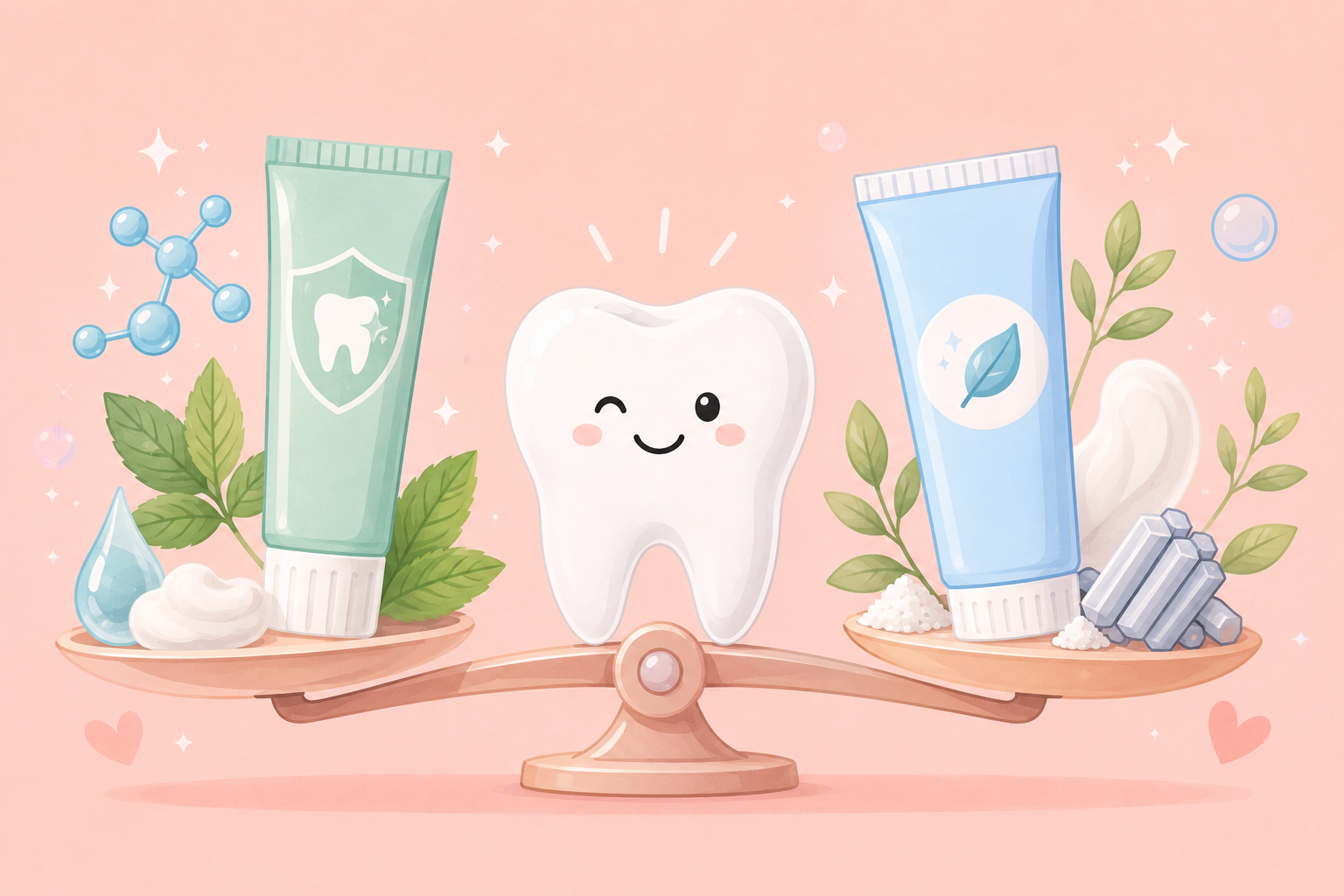
Neither is "better" in absolute terms, they're solving the same problem with different chemistry. Fluoride reinforces; nHAp rebuilds. Many people rotate between the two, or choose based on what stage their enamel is at. That's exactly why SAINT offers both: so you can match the formula to your mouth, not the other way around.
Choose Based on Tooth Sensitivity

If sensitivity is your primary concern, both fluoride and nano-hydroxyapatite can help, through different mechanisms. Fluoride reduces sensitivity over time by strengthening enamel against acid erosion. Nano-hydroxyapatite addresses it more directly by physically sealing dentinal tubules, the microscopic channels that connect the tooth surface to the nerve.
A systematic review and meta-analysis confirmed that both approaches produce meaningful reductions in dentin hypersensitivity, each through a different pathway. A double-blind randomized controlled trial found that nano-HAP toothpaste produced significant reductions in cold air and tactile sensitivity scores comparable to fluoride benchmarks at both 2 and 4 weeks. Either can be effective, the choice may come down to whether you want structural tubule sealing (n-HA) or enamel fortification (fluoride) as your primary sensitivity mechanism.
Choose Based on Life Stage
Young children
Both fluoride and nano-hydroxyapatite toothpastes are used for children. Fluoride at age-appropriate concentrations is widely recommended for cavity prevention in children and has an extensive pediatric evidence base. Nano-hydroxyapatite is gaining traction for children because it carries no fluorosis risk from accidental ingestion, a practical consideration for young children who may swallow toothpaste. Both are safe when used as directed at formulations appropriate for the child's age. Your pediatric dentist is the right resource for an individualized recommendation.
Adults with specific dental needs
Adults undergoing orthodontic treatment face elevated demineralization risk around brackets, where plaque accumulates in hard-to-clean areas. Both fluoride and nano-hydroxyapatite address this through their respective remineralization mechanisms, fluoride by chemically strengthening enamel against acid attack, n-HA by physically rebuilding mineral density and sealing vulnerable surface areas. Either can be part of an effective orthodontic prevention routine. The most important variable is consistency: twice-daily use of a well-formulated remineralizing toothpaste, combined with thorough cleaning around brackets, matters more than which active ingredient is chosen. Your orthodontist can advise on what fits your specific treatment and risk profile.
Adults focused on enamel maintenance and whitening
For adults with good oral health who are primarily focused on maintaining enamel quality, managing sensitivity, and supporting a whitening routine, nano-hydroxyapatite's structural remineralization mechanism is well-suited to these goals. Dense, smooth enamel reflects light more evenly and tolerates whitening better, which is why pairing n-HA toothpaste with a whitening routine is an evidence-supported approach.
Choose Based on Your Whitening Goals

If whitening is part of your routine, the toothpaste you use between sessions matters. Peroxide-based whitening temporarily increases enamel permeability, and the enamel recovery window between sessions is where your toothpaste does its most important work. Nano-hydroxyapatite deposits mineral into the temporarily more permeable enamel surface, supporting recovery and reducing sensitivity accumulation over a whitening course. Fluoride provides the ongoing acid resistance that keeps whitened enamel durable.
SAINT Whitening Strips use dentist-calibrated peroxide alongside bromelain, coconut oil, white turmeric, and Dead Sea salt, an approach that pairs active whitening with enamel-supportive ingredients rather than relying on peroxide alone. Paired with SAINT Mint Toothpaste for remineralization support between sessions, the combination covers both the whitening and the enamel recovery sides of the routine.
What to Look For Beyond the Fluoride Question
Once you have decided on the active remineralizing ingredient, the rest of the formula matters as much as that choice. These are the variables that determine whether a toothpaste actually performs:
-
SLS-free formula: SLS denatures the mucosal protein layer inside the mouth. For anyone with sensitive tissue or canker sore history, SLS-free is worth prioritizing
-
Low or published abrasivity: High-abrasivity formulas wear enamel cumulatively. A toothpaste that publishes its RDA and REA values is operating with meaningful transparency
-
Supporting antimicrobials: Plant-derived xylitol selectively reduces cariogenic bacteria without disrupting beneficial oral flora, a meaningful addition to any formula
-
Gum support: Aloe vera's anti-inflammatory properties support gingival health - particularly relevant for people with sensitivity or gum margin irritation
-
pH balance: An alkaline or neutral pH preserves both fluoride and n-HA activity in the formula and supports the natural remineralization environment
-
n-HA source and third-party verification: Both fluoride and fluoride-free formulas built around nano-hydroxyapatite should specify the n-HA source. Pharmaceutical-grade nanoXIM, the only n-HA approved for use in Europe, with independent verification through third-party testing like Intertek is the quality standard worth looking for in either version
Both SAINT Mint Toothpaste with fluoride and fluoride-free are built around rod-shaped nanoXIM n-HA in the 20-80nm range, SLS-free, formulated at pH 9, with aloe vera, coconut oil, plant-derived xylitol, tea tree oil, and cold-pressed spearmint. Both are manufactured in the USA in an FDA-compliant facility and verified through Intertek third-party testing.
The choice between them comes down to your personal preference and oral health needs, not to one being a better formula than the other.
FAQs About Choosing Between Fluoride and Fluoride-Free
1. Is there a simple rule for choosing between fluoride and fluoride-free?
Not a universal one, which is the honest answer. Higher cavity risk, orthodontic treatment, dry mouth, and frequent decay history are all factors that make discussing fluoride with your dentist worthwhile. Lower cavity risk, preference for fluoride-free care, and sensitivity as a primary concern are factors that make a well-formulated n-HA toothpaste a clinically supported choice. Both can be part of a healthy routine.
2. Can I use both fluoride and fluoride-free toothpaste?
Yes, they work through complementary mechanisms and are compatible in the same routine. Some people use a fluoride toothpaste in the morning for acid protection and a nano-hydroxyapatite toothpaste at night for structural remineralization support. There is no evidence that alternating between properly formulated products causes harm.
3. Is fluoride-free toothpaste effective enough on its own?
For people with lower cavity risk, a 2026 systematic review confirmed that hydroxyapatite toothpastes have clinically proven caries-preventive efficacy across all age groups. For people with higher risk or specific clinical needs, discussing fluoride with a dentist is recommended. Efficacy depends on the active ingredient, the formulation quality, and consistent daily use.
4. Which is better for sensitive teeth?
Both can reduce sensitivity, fluoride through enamel strengthening over time, nano-hydroxyapatite through direct dentinal tubule sealing. A randomized controlled trial found significant sensitivity reductions with nano-HAP toothpaste at both 2 and 4 weeks. The right choice depends on whether enamel fortification or structural tubule occlusion better addresses your sensitivity pattern.
5. Does it matter which fluoride-free toothpaste I choose?
Yes, significantly. Nano-hydroxyapatite quality varies widely between products. Rod-shaped particles in the 20-80nm range from pharmaceutical-grade sources like nanoXIM, the only n-HA approved for use in Europe, have the strongest clinical evidence and regulatory safety backing. Products that don't specify particle morphology or source may be using lower-quality forms. Third-party verification through organizations like Intertek provides additional quality assurance.
6. Should children use fluoride or fluoride-free toothpaste?
Both are used for children with good outcomes. Fluoride at age-appropriate concentrations has an extensive pediatric caries-prevention evidence base. Nano-hydroxyapatite carries no fluorosis risk from accidental ingestion, which is a practical consideration for young children. The right choice depends on the child's cavity risk and dentist recommendation, both options are safe when used as directed at appropriate formulations.