Understanding How Fluoride and Fluoride-Free Toothpaste Work
The fluoride versus fluoride-free debate in oral care has become unnecessarily polarized. Some sources present fluoride as the only credible option. Others position fluoride-free as categorically superior. The clinical reality is more useful than either extreme: both approaches have genuine evidence behind them, they work through different mechanisms, and the right choice depends on individual needs rather than tribal loyalty to one ingredient. Understanding how each actually works is what allows you to make a genuinely informed decision.

Why Teeth Need Daily Mineral Support
Before comparing the two approaches, it helps to understand what both are trying to accomplish. Every day, the bacteria in dental plaque metabolize sugars and produce acids that dissolve minerals from tooth enamel, a process called demineralization. Saliva partially reverses this by buffering those acids and redepositing calcium and phosphate onto enamel surfaces. The balance between mineral loss and mineral replacement is what determines whether early enamel damage stays manageable or progresses toward a cavity.
Both fluoride and fluoride-free remineralizing ingredients work within this cycle. The difference is in the mechanism, and understanding the mechanism is what makes the comparison meaningful.
How Fluoride Toothpaste Works
Fluoride's mechanism is chemical. When fluoride interacts with calcium and phosphate in enamel, it forms fluorapatite, a mineral that is more acid-resistant than the natural hydroxyapatite enamel is made of. This means fluoride-treated enamel is harder for bacteria to demineralize. Fluoride also inhibits the enzyme systems that bacteria use to metabolize sugar, providing a secondary antimicrobial effect.
The clinical evidence for fluoride is extensive and well-established. A systematic review found strong evidence that daily use of fluoride toothpaste prevents caries in the permanent dentition with a prevented fraction of approximately 24.9% compared to placebo, one of the most replicated findings in preventive dentistry. Fluoride's caries-prevention evidence has been built across decades of clinical trials and continues to be recognized by major dental organizations worldwide.
How Fluoride-Free Toothpaste Works
Modern fluoride-free toothpaste is not simply fluoride removed from a conventional formula. The most evidence-backed fluoride-free approach uses nano-hydroxyapatite, and it works through a fundamentally different mechanism than fluoride.
Where fluoride chemically modifies enamel to make it more acid-resistant, nano-hydroxyapatite physically rebuilds it. Because hydroxyapatite is the same mineral that makes up approximately 97% of tooth enamel, rod-shaped n-HA particles in the 20-80nm range can bind directly to enamel surfaces, fill microscopic defects, deposit calcium and phosphate into demineralized zones, and seal exposed dentinal tubules. It is a structural repair mechanism rather than a chemical fortification one.
The clinical evidence for n-HA has grown substantially. A 2026 systematic review evaluating fluoride-free active ingredients in toothpastes found that hydroxyapatite toothpastes demonstrated clinically proven caries-preventive efficacy across children, adolescents, and adults, making n-HA the most evidence-backed fluoride alternative currently available. A 2022 scoping review of 28 studies further confirmed consistent evidence of remineralization effects, sensitivity reduction, and enamel repair across the n-HA research body.
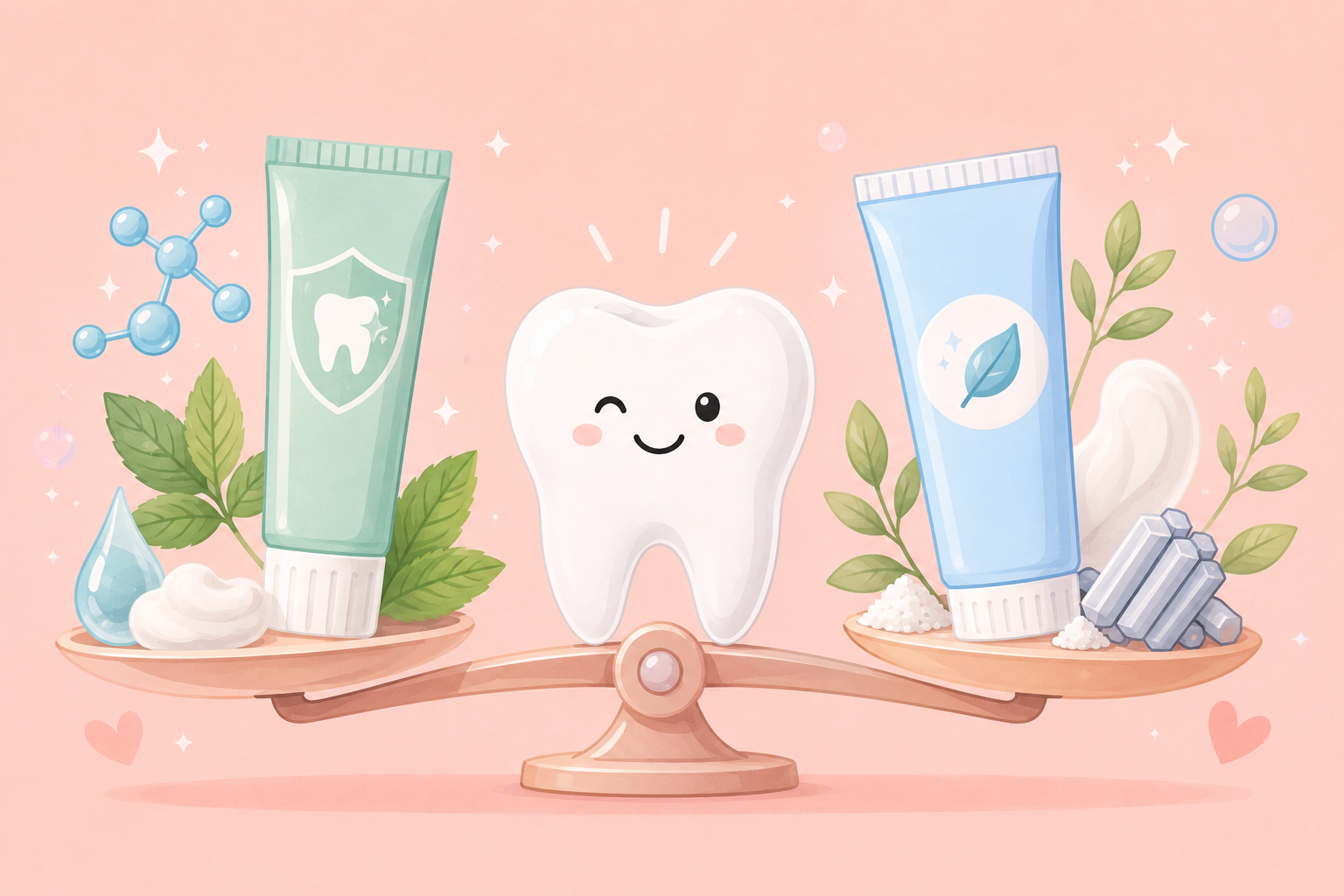
How They Compare: Same Goal, Different Routes
Caries prevention
Fluoride has decades of systematic review-level evidence for caries prevention across multiple populations and age groups. Nano-hydroxyapatite has a well-established and growing clinical evidence base, with trials demonstrating comparable efficacy to fluoride in remineralization outcomes. The 2026 systematic review confirmed n-HA as a clinically validated option for caries prevention across children, adolescents, and adults. Both are supported by peer-reviewed clinical evidence.
Sensitivity relief

Fluoride reduces sensitivity by strengthening enamel against acid attack over time. Nano-hydroxyapatite reduces sensitivity by physically sealing dentinal tubules, the microscopic channels that transmit sensitivity signals to the nerve. A systematic review and meta-analysis found that both n-HA and fluoride produced meaningful reductions in dentin hypersensitivity, with each working through a different mechanism. People with sensitivity can benefit from either approach depending on their individual response and oral health profile.
Surface brightness
Neither fluoride nor nano-hydroxyapatite bleaches teeth. Both can improve the optical appearance of teeth over time, fluoride by strengthening enamel, n-HA by smoothing the surface and filling microscopic irregularities that cause light to scatter unevenly. Denser, smoother enamel reflects light more evenly and appears naturally brighter.
Safety profile
Both are safe when properly formulated. Fluoride carries a fluorosis risk if significantly overconsumed during tooth development, primarily a concern for young children who may swallow toothpaste. Nano-hydroxyapatite has no known toxicity at oral care concentrations and does not carry the same ingestion concern, making it particularly well-suited for young children. Both are appropriate for adult daily use.
Can they be combined?
Yes. Fluoride and nano-hydroxyapatite work through complementary mechanisms and are compatible in the same formula. Using a fluoride toothpaste and an n-HA-based product in the same routine, or alternating between them, covers both chemical acid resistance and structural remineralization. Neither cancels the other out.
Who Benefits Most From Each Approach

Fluoride toothpaste is particularly well-suited for:
-
People with higher cavity risk or a history of frequent caries
-
Those in orthodontic treatment where plaque control is more difficult
-
People whose dentist has specifically recommended fluoride-based prevention
-
Those whose dentist recommends fluoride-based prevention for their specific oral health needs
Nano-hydroxyapatite toothpaste is particularly well-suited for:
-
People who prefer fluoride-free oral care for personal or health reasons
-
Those with significant tooth sensitivity where direct tubule occlusion is beneficial
-
Young children, as both fluoride and n-HA are safe when used as directed at age-appropriate formulations
-
People who want to pair their whitening routine with enamel structural support
What SAINT Offers for Both Approaches
Rather than taking a position in the fluoride debate, SAINT offers both. SAINT Mint Toothpaste with fluoride and SAINT Mint Toothpaste fluoride-free are both built around rod-shaped nanoXIM nano-hydroxyapatite in the 20-80nm range, sourced exclusively from nanoXIM, the only nano-hydroxyapatite approved for use in Europe, alongside aloe vera, coconut oil, plant-derived xylitol, tea tree oil, calcium, and cold-pressed spearmint. Both are SLS-free, formulated at pH 9, and manufactured in the USA in an FDA-compliant facility.
The fluoride version adds fluoride's chemical acid-resistance to n-HA's structural remineralization, covering both mechanisms in one formula. The fluoride-free version delivers the full n-HA benefit without fluoride exposure, verified through third-party testing with Intertek and backed by head-to-head performance data against leading brands in both remineralization and tubule occlusion.
FAQs About Fluoride vs Fluoride-Free Toothpaste
1. Is fluoride toothpaste still necessary?
Both fluoride and nano-hydroxyapatite have clinical evidence supporting caries prevention. A systematic review found strong evidence for fluoride toothpaste preventing approximately 24.9% of caries compared to placebo, while a 2026 systematic review confirmed n-HA toothpastes have clinically proven caries-preventive efficacy across all age groups. The right choice depends on individual oral health needs, personal preference, and your dentist's recommendation - not on one being universally superior.
2. Does fluoride-free toothpaste actually work for cavity prevention?
Yes, with the right active ingredient. A 2026 systematic review of fluoride-free toothpaste clinical trials found that hydroxyapatite toothpastes demonstrated clinically proven caries-preventive efficacy across all age groups, establishing n-HA as the most evidence-backed fluoride alternative currently available.
3. Is nano-hydroxyapatite as effective as fluoride?
Both have strong clinical support, each through a different mechanism. Multiple clinical trials have found n-HA comparable to fluoride for remineralization outcomes. For dentin hypersensitivity, a systematic review and meta-analysis confirmed both n-HA and fluoride produce meaningful sensitivity reductions. Fluoride works chemically; n-HA works structurally. The best option depends on which mechanism better suits your individual oral health profile.
4. Can I use both fluoride and nano-hydroxyapatite?
Yes. They work through complementary mechanisms and are compatible in the same formula or the same daily routine. Fluoride provides chemical acid resistance; n-HA provides structural remineralization. Using both covers more of the enamel protection spectrum than either alone.
5. Which is better for sensitive teeth?
Both can help with sensitivity, through different mechanisms. Fluoride strengthens enamel against acid attack, reducing sensitivity over time as enamel becomes more resistant. Nano-hydroxyapatite physically seals dentinal tubules, addressing the structural pathway through which sensitivity occurs. Both approaches are supported by clinical evidence for sensitivity reduction, the right choice depends on your specific sensitivity pattern and overall oral health goals.
6. Is fluoride-free toothpaste safe for children?
Yes. Nano-hydroxyapatite has no known toxicity at oral care concentrations and does not carry fluorosis risk from accidental ingestion, making it well-suited for young children who may swallow toothpaste. Fluoride is also safe for children when used at age-appropriate concentrations under adult supervision. The right choice depends on cavity risk, age, and parental preference.
7. Does it matter which brand of nano-hydroxyapatite toothpaste I choose?
Yes, significantly. Particle shape, particle size, and source quality all vary between products. Rod-shaped particles in the 20-80nm range from pharmaceutical-grade sources like nanoXIM, the only n-HA approved for use in Europe, have the strongest clinical evidence and the most favorable regulatory safety profile. Products that do not specify morphology or source may be using lower-quality or less-studied forms.