PFAS-Free Dental Floss: What It Means and Why People Are Switching
Most people do not think much about what coats their dental floss. If it slides between the teeth and does not snap, it usually feels like it is doing its job.
That is changing as more shoppers look for PFAS-free dental floss. The U.S. Environmental Protection Agency explains that PFAS are a large group of manufactured chemicals. They are used in many consumer and industrial products, and many break down very slowly.
That does not mean every conventional floss is dangerous. It also does not mean a PFAS-free label automatically makes a product better. A more useful question is what the floss is made from. You should also consider how it feels and whether you can use it consistently.
That full-formula approach matters across oral care. It is the same reason we recommend looking closely at oral care ingredients instead of judging a product by one claim on the package.

TL;DR
PFAS-free dental floss is made without intentionally added PFAS, a broad family of fluorinated chemicals used in many consumer products. Choosing PFAS-free floss can reduce one avoidable source of these materials, but the label is only part of the picture. Good floss should also glide comfortably, resist shredding, stay strong during use, and help you clean between teeth consistently.
What Are PFAS, and Why Can They Show Up in Dental Floss?
PFAS are a large family of manufactured fluorinated chemicals. Some have been used because they resist water, oil, heat, and friction. Certain dental flosses have used fluorinated materials such as PTFE to create a smooth, low-friction thread.
The EPA describes PFAS as long-lasting chemicals that break down very slowly. There are thousands of different PFAS, so the term covers a broad group rather than one single ingredient.
One material that often comes up in floss discussions is PTFE, or polytetrafluoroethylene. A 2019 study published in the Journal of Exposure Science & Environmental Epidemiology screened floss products for fluorine as an indicator of PTFE.
It is also important not to confuse PFAS with fluoride. Fluoride used in oral care is chemically different from fluorinated polymers such as PTFE. The Danish Consumer Council THINK Chemicals also makes this distinction.
Does Dental Floss Actually Contain PFAS?
Some dental floss products have used materials associated with the PFAS family, but PFAS are not present in every floss. In a 2019 study, researchers screened 18 floss products and detected fluorine in six. They also found a link between reported Oral-B Glide use and higher PFHxS blood levels. The study did not prove that floss caused those levels.
The 2019 study included 178 middle-aged women and examined several possible PFAS exposure sources. Reported Glide use was associated with 24.9% higher PFHxS in that study population. The researchers called for more work to confirm the exposure pathway.
Newer research makes the picture more complex. A 2025 analysis of 6,750 U.S. adults found lower PFAS levels overall among people reporting floss use. PFOA was the exception and was slightly higher. The authors said more research is needed to clarify the role of floss in PFAS exposure.
That means the evidence does not support the simple idea that “flossing raises PFAS.” PFAS exposure can also come from many other sources, including water, food, dust, workplaces, and consumer products, according to the EPA's current PFAS guidance.
Choosing PFAS-free floss can still be a practical preference. It lets you avoid an intentionally added fluorinated material when a suitable alternative is available.
What Does “PFAS-Free Dental Floss” Actually Mean?

A PFAS-free dental floss claim should mean that PFAS are not intentionally used in the floss material or coating. It is mainly a formulation and transparency claim. It does not prove that the product is automatically safer, more effective, or free from every possible trace contaminant.
Labels can make this harder than it sounds. The Danish Consumer Council tested 59 floss products and reported PTFE in 20, showing why shoppers may want clearer information about thread and coating materials.
When comparing floss, ask a few simple questions:
-
Is it described as PFAS-free or PTFE-free?
-
What is the thread made from?
-
What coating creates the glide?
-
Does the brand explain its materials clearly?
-
Does the floss work comfortably between your teeth?
A PFAS-free spool that constantly shreds or gets stuck may not be a good fit. “Free from” claims are most useful when they come with material transparency and good everyday performance.
PFAS-Free Is Only One Part of Choosing Better Floss

A floss can have a thoughtful ingredient story and still be frustrating to use. Physical design matters too. The thread has to move through tight spaces without becoming painful, weak, or difficult to control.
Glide affects how easily floss moves through tooth contacts. Durability matters because floss is pulled, wrapped, and moved against tooth surfaces, while shred resistance helps it stay intact during cleaning.
Products can differ quite a bit. A 2025 study comparing 18 commercial dental flosses found differences in width, filament diameter, maximum load, and elongation. Price did not consistently predict several of those mechanical properties.
Comfort may be the most practical factor of all. If floss feels harsh or repeatedly sticks, it becomes easier to skip, which is why we look at floss as one part of a complete daily oral care routine.
What Makes Dental Floss Effective for Daily Plaque Removal?
Dental floss works mainly through mechanical cleaning. It moves along the sides of teeth and near the gumline. This helps remove plaque in spaces a toothbrush cannot clean as directly. Good technique and regular use matter more than any single coating ingredient.
The American Dental Association recommends cleaning between teeth once a day. The ADA also states that floss or another interdental cleaner used with toothbrushing can reduce plaque and gingivitis more effectively than brushing alone.
Evidence is not equally strong for every interdental method. A Cochrane review of home interdental cleaning found that adding floss or interdental brushes to brushing may reduce plaque or gingivitis, while also noting limits in the certainty of the evidence.
The takeaway is simple: do not stop flossing because a PFAS headline sounds alarming. Choose materials you are comfortable with, then focus on consistent technique and a floss that makes thorough cleaning easier.
If you are deciding between formats, our guide to traditional string floss explains why full-length floss can offer more control around each tooth.
A Closer Look at SAINT PFAS-Free Dental Floss
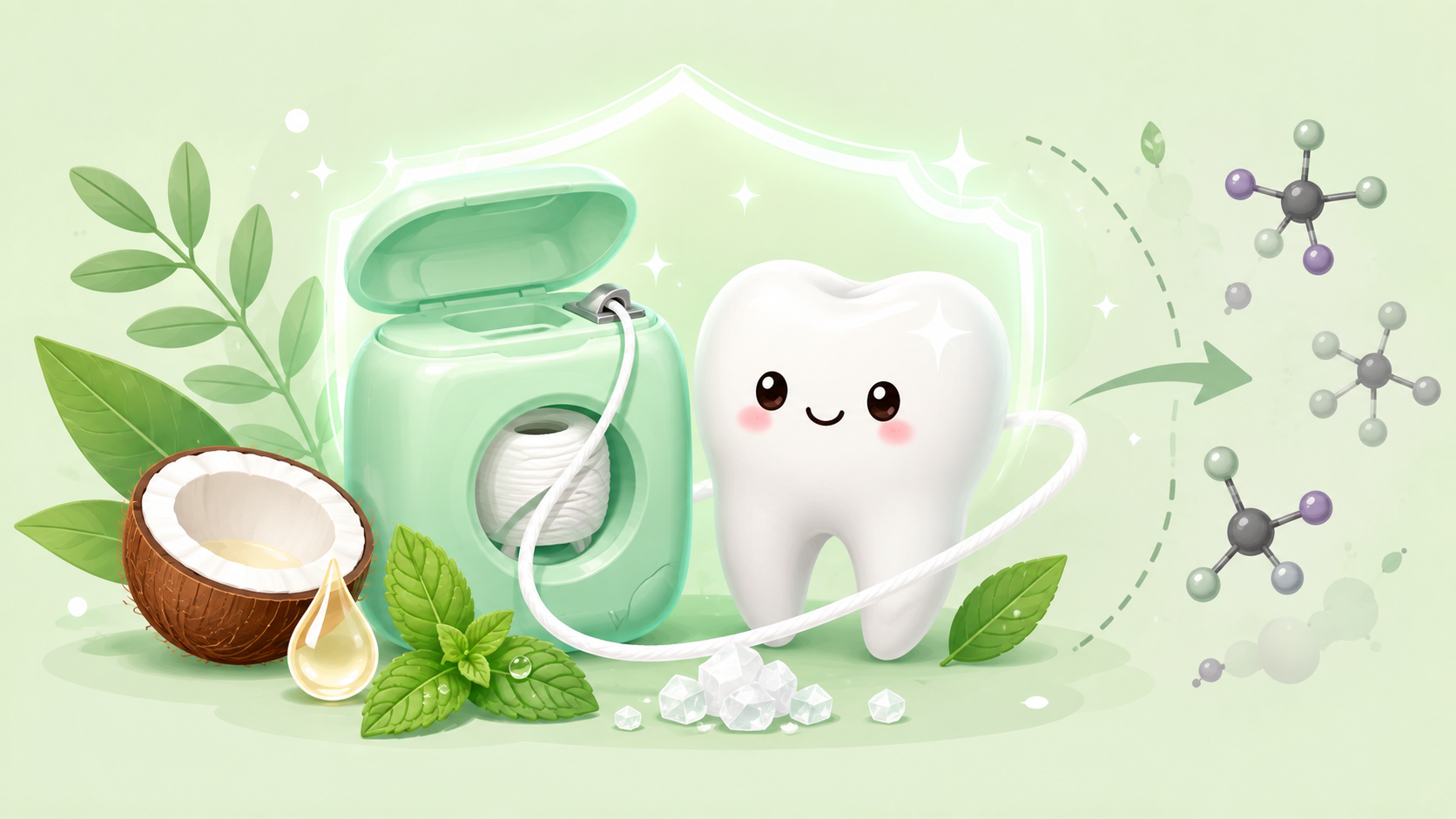
SAINT Floss is designed around both formulation and feel. It is PFAS-free and uses a soft, expandable, multi-thread construction with vegan wax, plus organic coconut oil, xylitol, and nano-hydroxyapatite.
The current SAINT Fresh Coconut Dental Floss uses more than 500 woven fibers. They are designed to expand with moisture. The product page identifies vegan wax as the glide coating and lists coconut oil, xylitol, and nano-hydroxyapatite.
Vegan wax provides glide without relying on a PFAS or PTFE coating. The woven thread is designed to expand between teeth and help lift plaque. Xylitol is included as a supporting ingredient, not the main cleaning mechanism.
A 2024 systematic review and meta-analysis found lower levels of cavity-linked bacteria with xylitol. The studies measured bacteria in plaque and saliva and compared xylitol with sorbitol or no sugar substitute. This does not mean xylitol-infused floss alone prevents cavities. It does help explain why xylitol can fit into a broader oral-care formula.
Nano-hydroxyapatite is another complementary ingredient. Clinical research has studied hydroxyapatite toothpaste for enamel remineralization and caries prevention, but with floss, the main plaque-removing action still comes from the thread itself.
You can learn more about how SAINT approaches this mineral on our nano-hydroxyapatite science page. The goal is a complete design: PFAS-free materials, comfortable glide, expandable thread, and thoughtfully selected supporting ingredients.
PFAS-free is a meaningful claim worth looking for on a floss label, and the research showing higher PFAS levels in some floss users is real, not manufactured concern. But that label alone can't tell you whether a floss shreds between your teeth, glides comfortably, or removes plaque as well as anything else on the shelf. Those answers come from the material, the coating, and how the floss actually performs in your mouth every night.
The smartest approach is to evaluate the whole formula, not just the absence of one chemical family, the same way you'd choose any other product that touches your teeth and gums daily. If you want a formula built around that exact standard, SAINT's Fresh Coconut Dental Floss is PFAS-free and Teflon-free by formulation, third-party tested as part of SAINT's standard testing process, made from plant-derived fibers, coated in vegan wax instead of PTFE, and infused with organic coconut oil and xylitol on a soft, textured multi-thread weave designed to resist shredding without needing a forever chemical to do it.
Looking Beyond a Single “Free-From” Claim
PFAS-free dental floss is worth considering if you want to avoid intentionally added PFAS in a product you use regularly. Still, the strongest choice is not based on one label alone. Look at the thread, coating, glide, durability, comfort, and resistance to shredding.
Most importantly, choose a floss that makes consistent cleaning realistic. The product still has to do its basic job well.
That same full-formula mindset applies across oral care. When evaluating whitening products, look at the active whitening ingredient, supporting ingredients, contact time, and directions instead of focusing on one “free-from” claim.
SAINT Whitening Strips combine hydrogen peroxide with nano-hydroxyapatite, coconut oil, bromelain, white turmeric, Dead Sea salt, and xylitol. The current directions call for a 30-minute wear time. That is another reason to evaluate whitening by both the formula and the directions.
Thoughtful oral care is rarely about one ingredient. It is about how the whole product is formulated and how well it fits into a routine you can keep.
Frequently Asked Questions
1. Does all dental floss contain PFAS?
No. PFAS are not used in every dental floss. A 2019 study that screened 18 floss products detected fluorine in six, showing that fluorinated materials were present in some products but not all.
2. Is PTFE in dental floss considered a PFAS?
PTFE is a fluoropolymer that falls within broad definitions of PFAS. It has been used in some floss because its low-friction surface can help the thread move through tight spaces, and the 2019 dental floss study screened for fluorine as an indicator of PTFE.
3. Does PFAS-free mean a dental floss is automatically safer?
No. PFAS-free tells you something useful about what the product is formulated without. It does not judge every other material or prove that the floss performs well. Consider the thread, coating, glide, strength, comfort, and how consistently you can use it.
4. How can I tell if my dental floss contains PFAS or PTFE?
Check the product page or packaging for terms such as PFAS-free, PTFE-free, Teflon-free, fluoropolymer, or PTFE. If the material is unclear, ask the manufacturer what the thread and coating contain. The Danish Consumer Council's floss testing shows why this transparency can matter.
5. What should I look for when choosing PFAS-free dental floss?
Look beyond the PFAS-free label. Choose floss that glides comfortably, resists shredding, stays strong during use, and lets you wrap the thread around each tooth. The ADA recommends daily cleaning between teeth, so ease of consistent use matters.