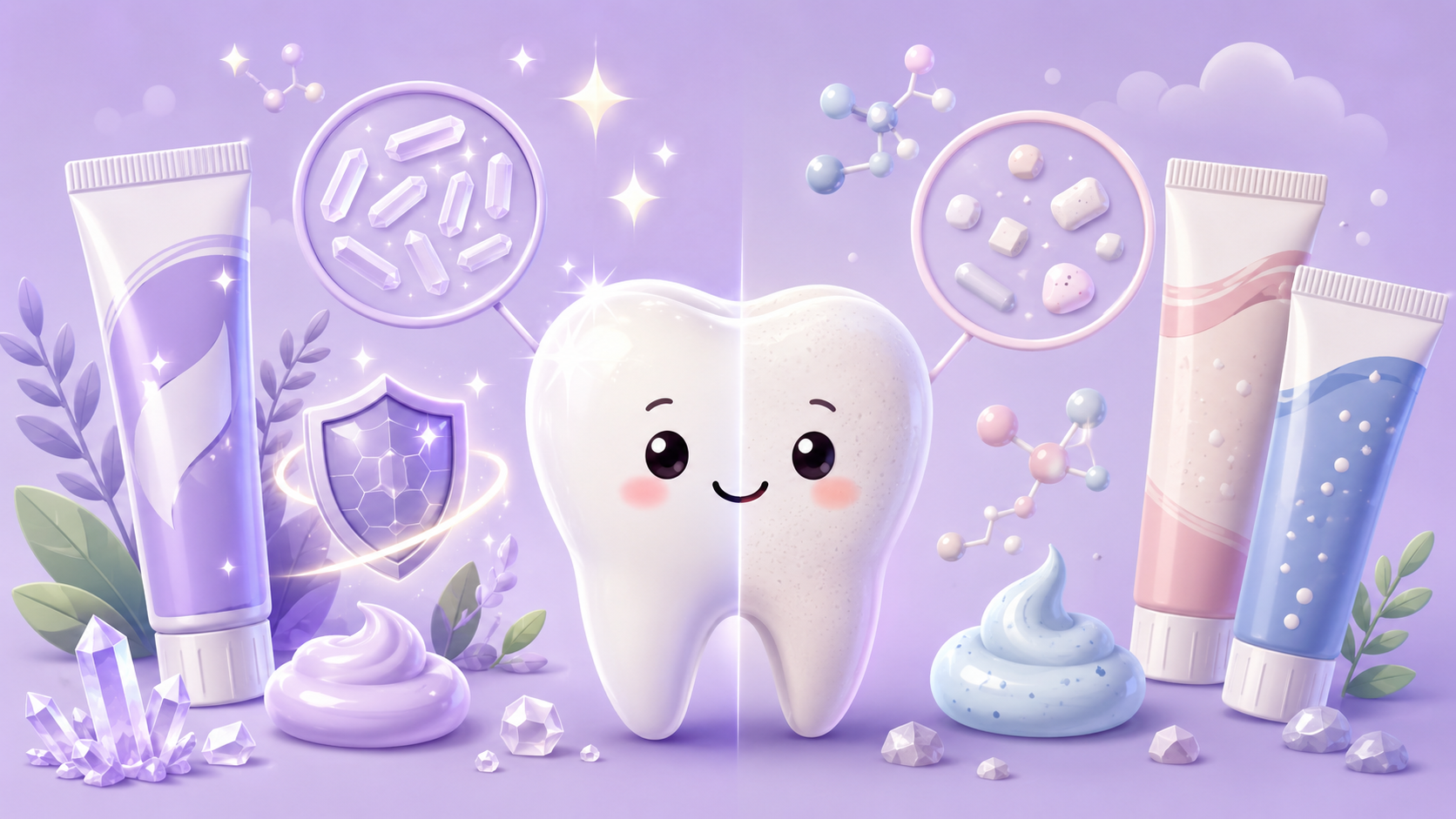
Why Not All Hydroxyapatite Toothpastes Are the Same
Hydroxyapatite is showing up in more toothpaste formulas, but that creates a new problem. It’s easy to assume that any tube with the ingredient on its label will work the same way.
That’s exactly why not all hydroxyapatite toothpastes are the same.
Research has linked hydroxyapatite toothpastes with enamel remineralization, protection against demineralization, and relief from dentin sensitivity. However, the formulas studied are not identical. A 2022 review of 28 hydroxyapatite studies found encouraging results across several oral-health outcomes while also calling for more standardized research.
The word “hydroxyapatite” on an ingredient list is only the beginning. Particle characteristics matter. So do concentration, cleaning ingredients, abrasivity, testing, fluoride content, and the rest of the formula.
Here’s what to look at before deciding which toothpaste belongs in your daily routine.

TL;DR
Not all hydroxyapatite toothpastes are formulated the same. Particle size, shape, concentration, purity, abrasivity, and the ingredients around hydroxyapatite can all differ. Instead of choosing a toothpaste because one trendy ingredient appears on the label, look at the complete formula. A well-designed toothpaste should combine enamel-supporting minerals with gentle cleaning ingredients and complementary oral-care ingredients.
Why Aren’t All Hydroxyapatite Toothpastes the Same?
Two hydroxyapatite toothpastes can use different particle sizes, shapes, concentrations, sources, and supporting ingredients. They can also use very different polishing and cleansing systems. That means seeing “hydroxyapatite” on two ingredient lists does not make the formulas equal.
Hydroxyapatite is a calcium-phosphate mineral closely related to the mineral structure of tooth enamel. Smaller nano-hydroxyapatite particles are used in oral care because they can interact with microscopic irregularities on the tooth surface. Clinical research has studied nano-hydroxyapatite for both remineralization and dentin sensitivity.
But the ingredient still has to work inside a complete toothpaste.
Imagine comparing two moisturizers that both contain hyaluronic acid. You would still look at the concentration, texture, other ingredients, and how the product is made. Toothpaste deserves the same level of attention.
A better question is not simply, “Does this contain hydroxyapatite?”
Ask: What kind of hydroxyapatite is being used, and what is it formulated with?
Particle Size, Shape, and Purity Matter
Nano-hydroxyapatite is not one perfectly uniform material. Particle characteristics can vary based on how the ingredient is produced.
Size is one important detail. “Nano” refers to particles measured on an extremely small scale. Shape, often called morphology in scientific literature, is another factor manufacturers can control.
These characteristics matter enough that regulators consider them when evaluating nano-hydroxyapatite safety. In its 2025 scientific opinion on nano-hydroxyapatite, the European Commission's Scientific Committee on Consumer Safety evaluated specific limits on particle size and shape when assessing use in toothpaste. It concluded that the evaluated material was safe at concentrations up to 29.5% in toothpaste when it met the stated specifications.
That does not mean shoppers need a microscope before buying toothpaste.
It does mean transparency matters. A brand that explains its particle specifications, sourcing, and testing gives you more information than a label that simply says “hydroxyapatite.”
For example, SAINT discloses on its nano-hydroxyapatite science page that its toothpaste uses rod-shaped nano-hydroxyapatite under 100 nm. SAINT also identifies purity and particle consistency as part of its ingredient standards.
Purity is another reason to look beyond a single ingredient name. Third-party testing and clear sourcing information can help you understand what is actually being used in the finished product.
Does Hydroxyapatite Concentration Matter?
Yes, concentration matters, but a higher percentage does not automatically mean a better toothpaste. Particle characteristics, formula design, the cleaning system, and how consistently you use the product also matter. A percentage is useful information, but it should not become the only number you compare.
This distinction matters because hydroxyapatite toothpastes are often marketed by percentage.
Research does not support treating concentration as a simple scoreboard. In an eight-week randomized controlled trial, toothpastes containing 10% and 15% nano-hydroxyapatite were both effective for dentin hypersensitivity. The study did not find a meaningful advantage from simply increasing the concentration from 10% to 15% for the measured outcomes.
That does not mean concentration is irrelevant. It means concentration needs context.
The specific material being used, how it is distributed throughout the toothpaste, and the surrounding ingredients can change the finished formula.
SAINT explores this issue in more detail in its guide to what makes nano-hydroxyapatite toothpaste effective.
When comparing products, use concentration as one piece of the puzzle, not the entire puzzle.
The Rest of the Toothpaste Formula Matters Too

Hydroxyapatite does not brush your teeth by itself.
A toothpaste also needs ingredients that help distribute the formula, clean the tooth surface, polish away deposits, create a pleasant texture, and leave your mouth feeling fresh.
This is where two hydroxyapatite toothpastes can become very different.
Abrasivity is one example. Toothpaste needs enough cleaning action to help remove surface buildup, but different formulas can produce different levels of enamel and dentin wear. A 2023 laboratory study comparing toothpaste abrasivity found significant differences in enamel and dentin wear between tested formulations with different abrasive characteristics.
Supporting ingredients matter too, although no single botanical or sweetener should be treated as a miracle ingredient.
SAINT's current fluoride-free nano-hydroxyapatite toothpaste combines nano-hydroxyapatite with hydrated silica, calcium carbonate, coconut oil, xylitol, baking soda, aloe vera, peppermint oil, spearmint oil, tea tree oil, and a coconut-derived cleansing agent.
Its fluoride nano-hydroxyapatite toothpaste uses the same core ingredient system with sodium fluoride added.
Xylitol is a good example of why supporting ingredients deserve attention without being overstated. Research continues to study xylitol-containing oral-care products, but outcomes depend on dose, delivery method, and the total formula. A 2024 clinical study of xylitol toothpaste found reduced levels of Streptococcus mutans with the tested formula after twice-daily use.
The goal is not to find the longest ingredient list. It is to find a formula in which each ingredient has a clear reason to be there.
Can Hydroxyapatite Toothpaste Help With Enamel, Sensitivity, and Whitening?
Hydroxyapatite toothpaste may support enamel remineralization and help reduce dentin sensitivity. It may also help teeth appear smoother and brighter, but it is not a peroxide bleaching treatment. Enamel support, surface stain removal, and chemical whitening are different processes, even when they all affect how your smile looks.
Research on enamel support is one of the strongest reasons hydroxyapatite has gained attention.
In a direct laboratory comparison, 10% hydroxyapatite showed comparable remineralization performance to 500 ppm fluoride under the conditions studied. More recent research has continued to examine hydroxyapatite for caries prevention and remineralization.
Sensitivity is another important area. A systematic review and meta-analysis of six randomized controlled trials found nano-hydroxyapatite showed a significant desensitizing effect in the studies evaluated.
You can read more about this process in our guide to nano-hydroxyapatite and enamel remineralization.
Whitening requires a little more nuance.
Hydroxyapatite can be part of a formula designed to support a smoother, brighter-looking tooth surface. Gentle polishing ingredients may also help remove external stains.
That is different from bleaching deeper discoloration with peroxide.
Understanding that difference makes it easier to choose the right product instead of expecting one ingredient to perform every oral-care job.
How Do You Choose a Better Hydroxyapatite Toothpaste?
Choose a hydroxyapatite toothpaste by evaluating the complete formula, not one front-label claim. Look at the form of hydroxyapatite, particle information when available, cleaning ingredients, fluoride content, testing standards, directions, and ingredients used alongside the mineral.
A simple checklist can make comparison easier:
- Check the type of hydroxyapatite. Does the brand specify nano-hydroxyapatite or only hydroxyapatite?
- Look for particle transparency. Does the company explain particle size or shape?
- Review the cleaning system. Look at the polishing and cleansing ingredients, not just the active mineral.
- Check the supporting ingredients. Xylitol, oils, botanical ingredients, and flavoring systems all contribute to the overall experience.
- Decide whether you want fluoride. Hydroxyapatite and fluoride do not have to be opposing choices.
- Look for testing and manufacturing transparency.
- Follow the directions. Even a thoughtfully designed formula needs consistent use.
For people who prefer fluoride-free care, recent research continues to examine hydroxyapatite as an alternative. A 2026 systematic review of fluoride-free toothpastes identified clinical trials studying fluoride-free hydroxyapatite formulas across children, adolescents, and adults.
People who prefer fluoride do not necessarily need to choose between the two ingredients. SAINT offers both a fluoride-free formula and a fluoride formula with nano-hydroxyapatite.
Your dentist can also help you choose based on your cavity risk, sensitivity, enamel condition, and dental history.
Your Whitening Routine Should Follow the Same Full-Formula Rule
The same thinking applies when you move from toothpaste to whitening.
One ingredient or one marketing phrase should not decide whether a whitening product is right for you. Look at the whitening active, the complete formula, how long the product stays on your teeth, and how the manufacturer tells you to use it.
Hydrogen peroxide remains a well-studied whitening active, but concentration matters. In a randomized clinical study comparing different hydrogen peroxide concentrations, the lower-concentration treatment produced less tooth sensitivity while still producing whitening under the conditions studied.
That is why “contains peroxide” and “peroxide-free” are both incomplete ways to judge a product.
Correct concentration and correct use matter.
Supporting ingredients can play different roles as well. For example, bromelain is an enzyme derived from pineapple. A randomized clinical trial comparing enzymatic and abrasive whitening toothpastes found that an enzyme-based formula containing papain and bromelain reduced external tooth stains during the study.
The current SAINT Whitening Strips formula combines coconut oil, nano-hydroxyapatite, bromelain, hydrogen peroxide, white turmeric, Dead Sea salt, and xylitol within the strip base. The product instructions call for applying the strips to dry teeth for 30 minutes before removing them and rinsing.
That is the same principle we use when thinking about toothpaste: evaluate the full formula and how it is meant to be used, not a single ingredient in isolation.
FAQs About Hydroxyapatite Toothpaste Quality
1. Are all hydroxyapatite toothpastes the same?
No. Hydroxyapatite toothpastes can differ in particle size, shape, concentration, ingredient source, abrasivity, and the supporting ingredients used in the formula. Research also uses different formulations, which is one reason results from one hydroxyapatite toothpaste should not automatically be applied to every product.
2. Is nano-hydroxyapatite better than regular hydroxyapatite in toothpaste?
Nano-hydroxyapatite uses much smaller particles and has been widely studied for remineralization and sensitivity applications. However, “nano” alone does not guarantee a better toothpaste. Particle characteristics, concentration, the rest of the formula, and product testing still matter.
3. Does a higher percentage of hydroxyapatite make a toothpaste better?
Not automatically. An eight-week randomized trial comparing 10% and 15% nano-hydroxyapatite toothpaste found both concentrations effective for dentin hypersensitivity, without a clear advantage from simply moving to the higher percentage for the study's measured outcomes.
4. Can hydroxyapatite toothpaste whiten teeth?
Hydroxyapatite toothpaste may help create a smoother, brighter-looking surface and can be paired with gentle polishing ingredients that remove external stains. It should not be confused with peroxide bleaching, which works through a different whitening mechanism. Research has separately studied hydroxyapatite for remineralization and peroxide for active tooth bleaching.
5. Should I choose hydroxyapatite toothpaste with or without fluoride?
That depends on your oral-health needs and preferences. Hydroxyapatite has been studied in fluoride-free formulas, while products can also combine hydroxyapatite and fluoride in the same toothpaste. Your dentist can help you decide based on factors such as cavity risk and enamel condition.