Floss Picks vs Traditional Floss: Why String Floss Wins for Daily Oral Health
Most people who use floss picks think they're doing enough. They're not, and the reason comes down to one motion floss picks physically cannot perform. Traditional string floss can wrap around the curved surface of each tooth and reach below the gumline. Floss picks can't. That single difference determines how thoroughly your teeth actually get cleaned every day. Recent ADA reporting confirms that traditional dental floss is considered the gold standard when properly applied because it can best access the gum sulcus to remove plaque.
The American Dental Association recommends cleaning between your teeth once a day because toothbrush bristles alone cannot reach those spaces. The tool you use to do it matters more than most people realize.
Why Cleaning Between Your Teeth Matters

Brushing covers roughly 60 percent of your tooth surface. The tight spaces between teeth and along the gumline are where bacteria and plaque quietly accumulate throughout the day, and where your toothbrush simply cannot reach. The ADA states that toothbrush bristles alone cannot clean effectively between tight spaces between teeth, and that floss and other interdental cleaners remove trapped food and bacterial film from those areas.
Left uncleaned, those areas can lead to:
- Gum irritation and bleeding
- Cavities forming between teeth
- Persistent bad breath
- Tartar buildup that requires professional removal
Clinical evidence supports flossing as a meaningful addition to brushing. Studies suggest that flossing alongside brushing can help reduce gingival inflammation compared to brushing alone. Consistent daily interdental cleaning is one of the simplest habits that protects your smile over time.
How Traditional Floss Works
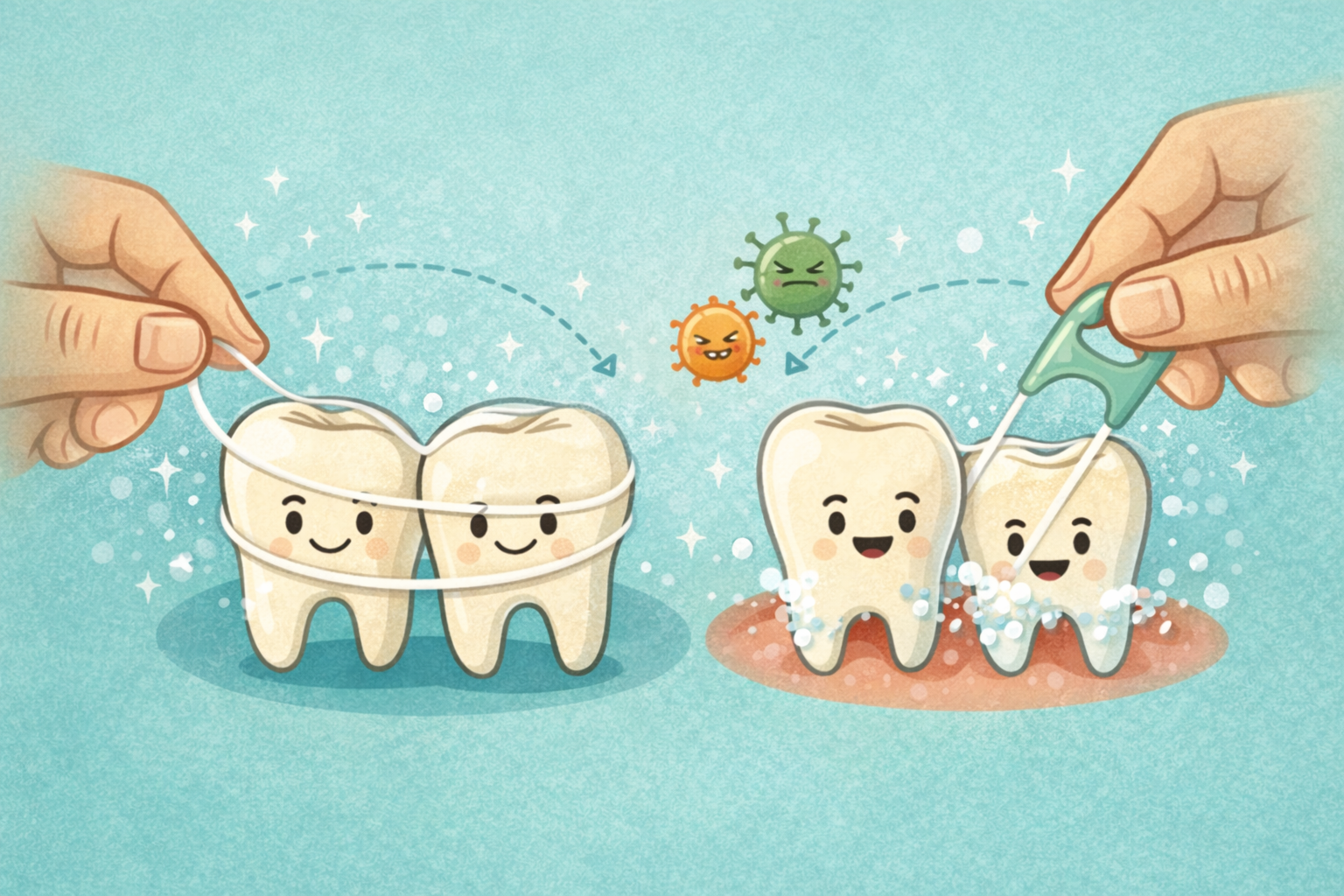
 Traditional string floss is a thin, flexible strand that slides between teeth and curves around the surface of each tooth. That C-shape wrapping motion is what makes it effective. Rather than just passing through the contact point between teeth, string floss can be guided gently along the tooth surface and slightly below the gumline, where plaque tends to collect before it causes problems.
The ADA’s flossing instructions specifically direct users to curve the floss into a C shape against the side of the tooth and rub it gently up and down. The ADA specifically recommends curving floss into a C-shape and moving it up and down against the side of the tooth rather than snapping it straight through.
Because you control the floss with your fingers, you can adjust the angle and pressure for every tooth individually, tighter spaces get more attention, sensitive areas get a gentler touch. That adaptability is something no fixed-floss tool can replicate.
How Floss Picks Work

Floss picks hold a short piece of floss stretched between two plastic prongs. They're simple to hold, require less technique, and work well as a backup option when you're traveling or eating out. The ADA recognizes multiple types of interdental cleaners including picks, and using one is better than skipping interdental cleaning entirely.
The limitation is structural. Because the floss is fixed in a plastic frame, it cannot perform the C-shape motion that makes traditional flossing effective. It moves in a back-and-forth motion rather than curving around the tooth, which means plaque along the sides and below the gumline is largely left behind. For a quick clean between meals, a floss pick is fine. As your daily flossing tool, it consistently falls short. Recent ADA reporting says traditional floss can best access the sulcus when used correctly, which supports this distinction in technique and reach.
Floss Picks vs Traditional Floss: Side by Side
| Traditional String Floss | Floss Picks | |
|---|---|---|
| Cleaning motion | Curves around each tooth in a C-shape | Fixed back-and-forth only |
| Gumline access | Guided gently below the gumline | Limited adaptation |
| Control | Full control over pressure and angle | Fixed position, less flexibility |
| Plaque removal | More thorough and complete | Partial, surface-level |
| Best for | Daily thorough cleaning | Travel, quick use between meals |
| ADA positioning | Gold standard for daily interdental cleaning | Recognized supplemental option |
Support for the C-shape motion, once-daily interdental cleaning, and traditional floss as the gold standard when properly applied comes from ADA guidance and ADA reporting.
Why the Wrapping Technique Makes All the Difference
The biggest advantage of traditional floss is not the material itself, it's the technique it enables. The ADA's flossing guidance is specific: curve the floss against the tooth, then move it up and down along the tooth surface. That motion cleans more thoroughly at and just below the gumline, which is exactly where early gum disease begins.
Recent ADA reporting confirms that traditional dental floss is considered the gold standard when properly applied, particularly because it can best access the gum sulcus to remove plaque. Floss picks, held in a rigid plastic frame, make that curved motion difficult to achieve consistently, which is why dental professionals continue to recommend string floss for daily use.
What to Look for in a Traditional Floss
Not all traditional floss is worth using every day. Conventional options often use synthetic coatings or materials that don't align with a cleaner approach to oral care. A well-formulated floss should:
- Glide smoothly without shredding or catching on tight contacts
- Be free from parabens, SLS, and PFAS
- Use ingredients that actively support oral health
- Feel comfortable enough that you actually want to use it daily
Ingredients matter here. Organic coconut oil helps floss glide smoothly between teeth while supporting a cleaner mouth environment. Plant-derived xylitol supports a balanced oral microbiome and helps reduce cavity-causing bacteria. Vegan wax provides the smooth texture that makes flossing comfortable rather than something to put off.
SAINT Dental Floss is built around exactly this kind of ingredient stack, organic coconut oil, plant-derived xylitol, and vegan wax, in a soft, multi-threaded design that cleans thoroughly without irritating gum tissue. It's completely free from parabens, SLS, and PFAS, making it a natural fit for anyone building a cleaner daily routine. It comes in three flavors, Fresh Coconuts, Wild Mint, and Tangerine and Citrus, which makes the habit significantly easier to stick to.
How to Floss Properly With Traditional Floss
Getting the technique right makes flossing far more effective. Following ADA guidance:
- Use about 18 inches so you have a fresh section for each tooth
- Slide gently, never snap, easing the floss into place protects gum tissue
- Curve into a C-shape against each tooth and move it up and down along the surface
- Guide it slightly below the gumline where plaque tends to collect
- Use a clean section for every tooth to avoid redistributing bacteria
- Floss once daily, nighttime is ideal so the day's buildup doesn't sit overnight
Once the technique feels natural, the whole process takes under two minutes.
Should You Floss Before or After Brushing?
The most important thing is doing both consistently, but there is clinical evidence that flossing before brushing offers an advantage. Randomized studies have found that flossing first can improve interdental plaque reduction and fluoride retention compared to brushing first. Loosening plaque before brushing allows your toothpaste to better reach the spaces between teeth. That said, sequence matters far less than consistency. Flossing daily with good technique, regardless of order, is what makes the real difference.
Building a Complete Routine Around Traditional Floss

Flossing works best as part of a complete daily oral care routine. A well-rounded approach includes:
- Brushing twice daily with a dentist-formulated toothpaste that supports enamel health
- Flossing once a day with a gentle, ingredient-conscious traditional floss
- Cleaning the tongue to remove bacteria that contribute to bad breath
- Staying hydrated to support saliva production and a balanced oral environment
The ADA supports brushing and daily interdental cleaning as core home-care habits.
Products formulated with ingredients like nano-hydroxyapatite, aloe vera, coconut oil, and xylitol work together to support enamel remineralization, gum health, and a cleaner mouth overall. When these habits stack consistently, the results show up in both how your mouth feels and how your smile looks over time.
FAQs About Floss Picks vs Traditional Floss
1. Are floss picks as effective as traditional floss?
Floss picks can remove some food debris and plaque, which is better than skipping interdental cleaning entirely. However, their fixed design prevents the C-shape wrapping motion the ADA recommends, making them less effective for thorough daily cleaning compared to traditional string floss.
2. Why do dentists recommend traditional floss over floss picks?
Traditional floss gives you full control over angle, pressure, and tooth contact. When used correctly with the C-shape technique, it can follow the contour of each tooth, clean both sides of the tooth surface, and reach below the gumline, none of which floss picks can do consistently.
3. Should I floss before or after brushing?
Either order is better than skipping it, but clinical studies suggest flossing before brushing can improve interdental plaque removal and fluoride retention. Flossing first allows your toothpaste to better penetrate the spaces between teeth.
4. How often should I floss?
The ADA recommends cleaning between your teeth once a day. Flossing at night is particularly effective because it removes the day's buildup before it sits overnight.
5. Can flossing improve gum health?
Yes. Clinical evidence shows that flossing alongside brushing helps reduce gingival inflammation compared to brushing alone. Most people notice healthier, less sensitive gums within a few weeks of consistent daily flossing.
6. Is coconut oil infused floss worth using?
Coconut oil helps floss glide more smoothly between teeth while supporting a cleaner mouth environment. When combined with xylitol, it adds meaningful oral health support beyond just mechanical cleaning, making the experience more comfortable and easier to maintain as a daily habit.
7. What makes SAINT Dental Floss different from conventional floss?
SAINT Floss uses a soft, multi-threaded design infused with organic coconut oil, plant-derived xylitol, and vegan wax. It's free from parabens, SLS, and PFAS, making it a cleaner, more intentional choice for people who care about what goes into their daily oral care routine.