The Full-Mouth Formula: Toothpaste, Strips, Floss, and Why Ingredients Should Work Together
It is easy to shop for oral care one ingredient at a time.
You see nano-hydroxyapatite and think enamel. You see xylitol and think oral health. You see peroxide and think whitening. Then another product promises to do all three.
But a better oral-care routine does not ask every product to do the same job.
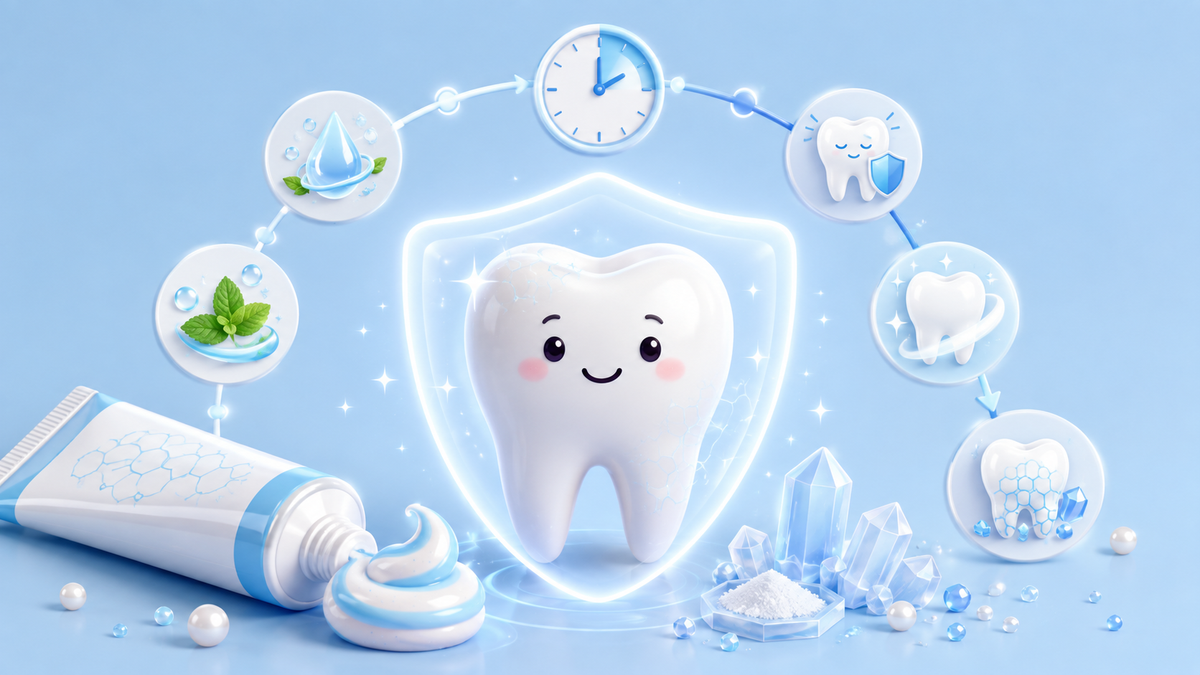
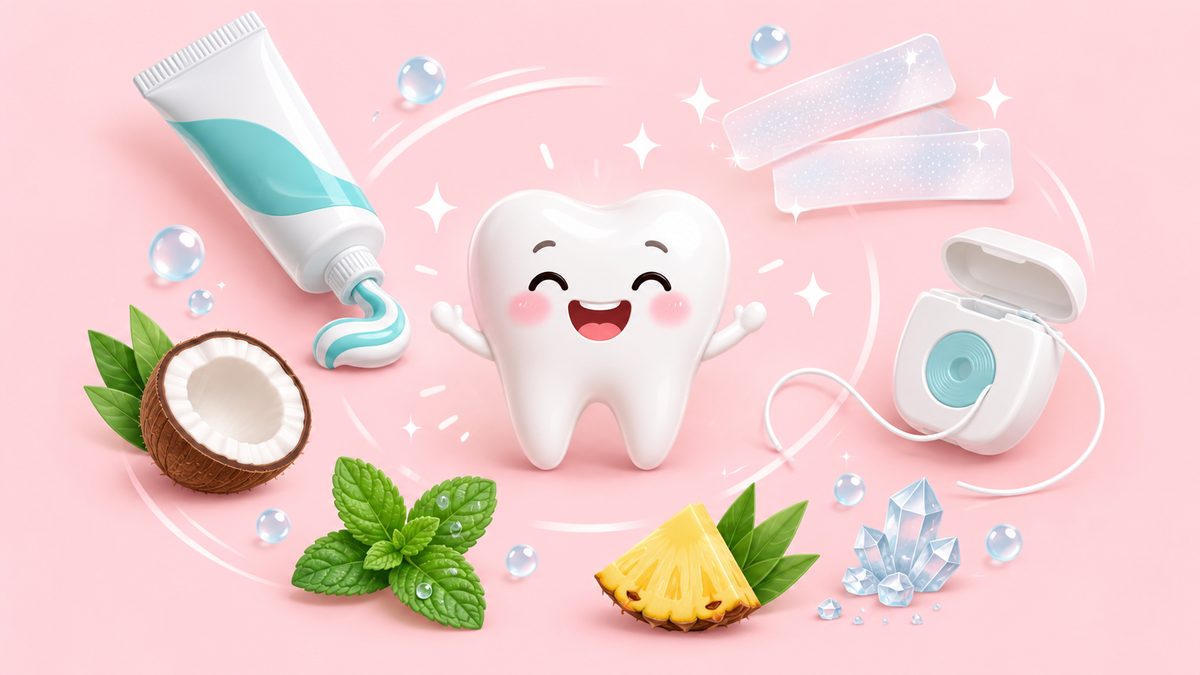
The Full-Mouth Formula: Toothpaste, Strips, Floss, and Why Ingredients Should Work Together is about giving each step a clear purpose. Toothpaste provides daily cleaning and enamel support. Floss physically reaches between teeth. Whitening strips address deeper discoloration through a different whitening mechanism.
Some ingredients can still appear across several products. That does not automatically make them redundant.
Nano-hydroxyapatite, xylitol, and coconut oil can support the broader formula in more than one delivery format. At the same time, an ingredient like hydrogen peroxide has a much more specific job.
The better question is not, "Which ingredient wins?"
It is, "Does the whole routine make sense?"

TL;DR
A complete oral-care routine works best when each product has a clear job. Toothpaste handles daily cleaning and enamel support, floss cleans between teeth, and whitening strips target discoloration that brushing alone cannot fully change. Ingredients like nano-hydroxyapatite, xylitol, and coconut oil can appear across several products for complementary support, while hydrogen peroxide has a specific bleaching role. The goal is not one hero ingredient. It is a formula that works together.
Why Doesn't One Oral-Care Product Do Everything?
A complete routine uses different products because brushing, interdental cleaning, enamel support, and chemical whitening solve different problems. Toothpaste cannot effectively clean every tight space between teeth, floss does not bleach deeper discoloration, and whitening strips cannot replace daily plaque removal.
That difference starts with where each product can physically reach.
The American Dental Association explains that toothbrush bristles alone cannot effectively clean tight spaces between teeth. That is why interdental cleaning still matters even if you brush thoroughly.
Whitening presents a different challenge.
The ADA separates tooth discoloration into extrinsic stains on the enamel surface and intrinsic discoloration within the tooth. Surface stains can often be reduced through mechanical cleaning. Deeper color changes may need chemical bleaching.
That gives each part of a complete routine a primary role:
- Toothpaste: daily cleaning, polishing, and enamel-focused care
- Floss: physical plaque and debris removal between teeth
- Whitening strips: peroxide-based bleaching for deeper shade change
Trying to make one product replace all three can blur these important differences.
A better system lets each product do what its delivery method is designed to do.
The Full-Mouth Formula Starts With Toothpaste

Toothpaste is the daily foundation of the routine.
Its first job is not to create the biggest possible shade change. It is to help clean the tooth surface while delivering ingredients designed for everyday oral care.
The ADA explains that toothpaste formulas can combine cleaning ingredients with active ingredients such as fluoride. Fluoride helps strengthen enamel and supports remineralization during the early stages of tooth decay.
SAINT's fluoride toothpaste combines sodium fluoride with nano-hydroxyapatite rather than treating the two ingredients as competitors.
The current formula also includes hydrated silica, calcium carbonate, coconut oil, xylitol, baking soda, aloe vera, peppermint oil, spearmint oil, and tea tree oil.
That combination reflects an important formula principle.
Some ingredients focus on cleaning. Others support enamel. Others help create the taste, texture, and overall brushing experience.
Nano-hydroxyapatite adds another enamel-focused ingredient to the routine. A 2024 systematic review examined products combining nano-hydroxyapatite and fluoride for the remineralization of early enamel lesions. A separate updated review found growing clinical evidence for hydroxyapatite-containing oral-care products in caries prevention.
You can read more about the mineral itself in our guide to nano-hydroxyapatite and enamel remineralization.
This does not mean toothpaste needs to perform every whitening job.
It means your toothpaste can create a strong daily foundation while another product handles deeper whitening when that is your goal.
What Do Whitening Strips Do That Toothpaste Cannot?
Whitening toothpaste mainly helps manage stains on the tooth surface. Hydrogen peroxide strips work differently because peroxide can move through dental hard tissues and oxidize colored compounds associated with deeper discoloration. That is why toothpaste and whitening strips can work together rather than compete.
This distinction matters because the word "whitening" is used for several different mechanisms.
A 2025 systematic review and meta-analysis of 14 randomized controlled trials found that whitening dentifrices can reduce extrinsic stain area and intensity. That makes toothpaste useful for surface stain management.
But removing surface stains is not the same as bleaching the underlying tooth color.
The ADA identifies hydrogen peroxide and carbamide peroxide as common bleaching ingredients. Hydrogen peroxide can pass through enamel and dentin, where oxidation changes colored compounds within the tooth.
This is why hydroxyapatite toothpaste and peroxide whitening should not be treated as interchangeable.
We explore that distinction further in our guide to hydroxyapatite toothpaste versus active whitening.
SAINT Whitening Strips use hydrogen peroxide for this deeper bleaching role, but peroxide is not the entire formula.
The current ingredient list includes:
- Coconut oil
- Deionized water
- Cellulose gum
- Carbomer
- Nano-hydroxyapatite
- Bromelain
- Hydrogen peroxide
- White turmeric
- Dead Sea salt (Maris Sal)
- Xylitol
Hydrogen peroxide provides the main deeper bleaching action. The other ingredients are part of the surrounding strip formula and should not be described as replacements for peroxide.
That distinction is important.
A formula can include supportive ingredients without pretending every ingredient performs the same job.
Why Does Floss Still Matter If You Brush Thoroughly?

Floss performs a job that toothpaste and whitening strips cannot replace. Its main benefit comes from physically moving between teeth and disrupting plaque on surfaces toothbrush bristles cannot effectively reach. Ingredients infused into floss can complement that mechanical action, but the thread itself remains the primary cleaning tool.
Plaque does not only collect on the surfaces you can easily reach with a toothbrush.
The ADA recommends cleaning between teeth daily because interdental cleaners help remove debris and interproximal plaque from hard-to-reach surfaces.
This is where floss design matters.
SAINT floss uses soft, textured, expandable woven fibers designed to increase contact with the sides of the teeth as the thread moves through interdental spaces.
The floss also includes nano-hydroxyapatite, xylitol, coconut oil, and vegan wax.
That ingredient list should be understood in the right order.
The floss thread does the physical cleaning. The infused ingredients play supporting roles within the formula.
This distinction is especially important with xylitol. Research on xylitol often studies delivery formats such as gums, candies, or other regularly used products rather than dental floss.
For example, a 2025 systematic review and meta-analysis examined xylitol-containing sweets and dental plaque accumulation. Evidence from one delivery method should not automatically be treated as proof that xylitol-infused floss produces the same clinical outcome.
That does not make the ingredient irrelevant.
It means the claim should match the product.
With floss, physical plaque removal remains the strongest reason to use it. The rest of the formula can make that daily step more thoughtful.
You can learn more about SAINT's approach in our guide to xylitol in toothpaste and floss and our guide to choosing PFAS-free dental floss.
The Full-Mouth Formula: Why Ingredient Overlap Makes Sense
Seeing the same ingredient in your toothpaste, strips, and floss can look repetitive.
It can also be intentional.
The key is understanding whether that ingredient supports the product's main job or replaces it.
| Ingredient or Feature | Toothpaste | Whitening Strips | Floss | Role Across the Routine |
|---|---|---|---|---|
| Nano-hydroxyapatite | Yes | Yes | Yes | Enamel-focused supporting ingredient used across several delivery formats. |
| Xylitol | Yes | Yes | Yes | Supporting oral-care ingredient that can complement the broader formula. |
| Coconut oil | Yes | Yes | Yes | Supporting formula ingredient used across the routine. |
| Hydrogen peroxide | No | Yes | No | Main active ingredient for deeper chemical bleaching. |
| Fluoride | Available in fluoride toothpaste | No | No | Established anticaries active that supports enamel remineralization. |
| Gentle polishing ingredients | Yes | No | No | Help clean the tooth surface and manage external stains. |
| Bromelain | No | Yes | No | Enzyme included as a supporting ingredient in the whitening formula. |
| Expandable woven fibers | No | No | Yes | Provide the physical interdental cleaning action. |
| Vegan wax | No | No | Yes | Supports comfortable glide and handling. |
The table shows why repeated ingredients do not make the products identical.
Nano-hydroxyapatite is a good example.
Hydroxyapatite has been studied in toothpaste and other oral-care applications for enamel-focused uses. A systematic review and meta-analysis of nano-hydroxyapatite for dentin hypersensitivity found favorable results in the included trials, while noting the need for longer-term studies.
That does not mean hydroxyapatite suddenly becomes the main reason whitening strips whiten or the main reason floss removes plaque.
The delivery system still defines the product's primary job.
The same principle applies to xylitol and coconut oil. Their presence can support formula continuity without turning them into universal hero ingredients.
This is why judging an oral-care system by its complete formula makes more sense than counting how many trending ingredients appear on the front label.
Is Peroxide Automatically Harsh on Teeth?
No. Hydrogen peroxide should not be judged only by whether it appears on an ingredient list. Whitening results and sensitivity depend on several factors, including concentration, exposure time, treatment frequency, product design, and correct use. A higher peroxide percentage is not automatically necessary for a useful whitening result.
Peroxide gets simplified into two extremes.
One side treats stronger as better. The other treats "peroxide-free" as automatically gentler.
The evidence is more nuanced.
The ADA notes that temporary tooth sensitivity and gingival irritation are the most common adverse effects associated with vital tooth whitening. It also explains that whitening products use different peroxide concentrations and treatment protocols.
A 2020 systematic review and meta-analysis compared higher and lower hydrogen peroxide concentrations used in tooth bleaching. The review included 14 studies in its qualitative analysis and found greater sensitivity with the higher-concentration protocols evaluated.
That does not create one universal "safe percentage" for every whitening strip.
It does show why concentration cannot be separated from the rest of the protocol.
Contact time matters. Frequency matters. Product fit matters. Following the directions matters.
SAINT Whitening Strips are designed to be worn for 30 minutes per treatment. Extending the wear time because "more must be better" changes the intended use of the product.
If you want a deeper explanation, read our guide to how much peroxide is too much for teeth whitening.
Peroxide also serves a different purpose from nano-hydroxyapatite.
Peroxide provides chemical bleaching. Nano-hydroxyapatite is used for enamel-focused support. Putting both in one routine does not mean one cancels out the other.
They simply have different jobs.
How to Evaluate a Full-Mouth Formula

A better oral-care routine starts by asking what each product is supposed to accomplish.
Do not begin with the ingredient printed in the biggest font.
Instead, work through the formula in this order:
-
What is the product's main job?
Toothpaste should clean effectively and support daily oral care.
Floss should physically clean between teeth.
Whitening strips should provide a clear whitening mechanism if deeper shade change is the goal. -
Which ingredient or feature performs that main job?
With whitening strips, hydrogen peroxide provides the main bleaching action.
With floss, the thread provides the mechanical cleaning.
With toothpaste, the cleaning system works alongside active or enamel-focused ingredients.
This keeps supporting ingredients in perspective. -
What role do the other ingredients play?
A formula can do more than one thing.
Nano-hydroxyapatite may be included for enamel-focused support. Xylitol may complement the broader oral-care formula. Coconut oil may be part of the supporting formulation.
The important part is not forcing every ingredient into a claim it cannot support. -
Does another product cover what this one cannot?
This is where the Full-Mouth Formula becomes useful.
Brushing does not eliminate the need for interdental cleaning.
Flossing does not provide peroxide bleaching.
Whitening strips do not remove the need to brush twice daily.
The products complement one another because their limitations are different. -
Are the directions clear?
An effective formula still needs correct use.
Pay attention to wear time, brushing instructions, floss technique, frequency, and any guidance provided by the manufacturer or your dental professional. -
Is the formula being judged as a whole?
One ingredient should not have to carry the entire product story.
This applies to "peroxide-free," "with xylitol," "with hydroxyapatite," "fluoride-free," and almost every other front-label claim.
Ask what is present, why it is there, how the product delivers it, and what evidence supports the intended use.
The Better Routine Is the One Where Every Step Has a Purpose
A complete oral-care routine does not need three products competing to do the same thing.
Toothpaste provides the daily cleaning and enamel-support foundation. Floss reaches the tight spaces brushing cannot effectively clean. Whitening strips can address deeper discoloration through peroxide-based bleaching.
Ingredients such as nano-hydroxyapatite, xylitol, and coconut oil can repeat across the routine because supporting ingredients do not have to appear in only one product.
What matters is that each formula still has a clear primary job.
So instead of searching for one miracle ingredient, look at the entire system. Check the active ingredients, supporting formula, delivery method, directions, and intended use.
If active whitening fits your goal, explore SAINT Whitening Strips, which combine hydrogen peroxide with nano-hydroxyapatite, bromelain, coconut oil, white turmeric, Dead Sea salt, and xylitol in one thoughtfully designed whitening formula.
Frequently Asked Questions
1. Can I use nano-hydroxyapatite toothpaste with whitening strips?
Yes, they can fit into the same oral-care routine because they serve different primary purposes. Nano-hydroxyapatite toothpaste supports daily cleaning and enamel-focused care, while peroxide whitening strips provide chemical bleaching for deeper discoloration. Follow each product's directions rather than increasing frequency or wear time.
2. Why is nano-hydroxyapatite used in toothpaste, floss, and whitening strips?
Nano-hydroxyapatite is an enamel-focused ingredient studied in several oral-care applications. Its presence across different products does not mean those products perform the same job. Toothpaste still cleans, floss still removes plaque physically, and peroxide remains the main bleaching active in peroxide whitening strips.
3. Do I still need to floss if I brush twice a day?
Yes. The ADA explains that toothbrush bristles cannot effectively clean every tight space between teeth. Daily interdental cleaning helps remove plaque and debris from surfaces your toothbrush may not fully reach.
4. Is hydrogen peroxide in whitening strips bad for enamel?
Hydrogen peroxide is a widely used dental bleaching ingredient, but how a whitening product is used matters. The ADA notes that sensitivity and gum irritation can occur with whitening, while research shows concentration and treatment protocol can influence sensitivity. Follow the recommended contact time and frequency instead of assuming more peroxide or longer wear is better.
5. Should every product in an oral-care routine contain the same ingredients?
No. Ingredient overlap can make sense, but each product should still have a clear purpose. Toothpaste, floss, and whitening strips use different delivery methods, so the most important ingredient or feature for one product may not be the most important for another.