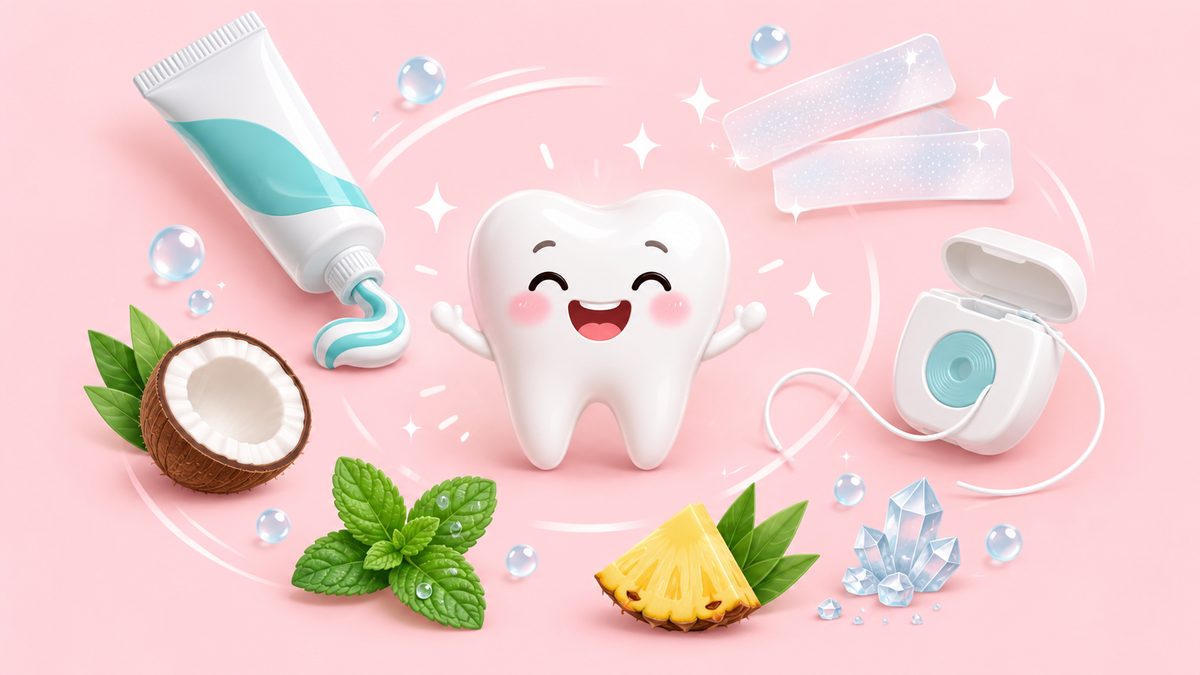
Fluoride Toothpaste With Nano-Hydroxyapatite: Why Some Formulas Use Both
If you have compared modern toothpastes lately, you may have noticed a divide. Some formulas focus on fluoride. Others promote nano-hydroxyapatite as an alternative.
That can make fluoride toothpaste with nano-hydroxyapatite sound contradictory. It is not.
The American Dental Association explains that fluoride strengthens teeth and supports enamel remineralization. Nano-hydroxyapatite, often shortened to n-HA, is a calcium-phosphate material studied for enamel remineralization and dentin sensitivity.
These ingredients do not work in exactly the same way. That is why some formulas use both.
Instead of asking which single ingredient “wins,” it is more useful to ask how the whole toothpaste is designed. The enamel-supporting ingredients matter, but so do the cleaning system, supporting ingredients, testing, and consistent use.

TL;DR
Fluoride and nano-hydroxyapatite do not have to compete. Fluoride helps strengthen enamel, support remineralization, and protect against cavities. Nano-hydroxyapatite supplies calcium-phosphate mineral similar to natural tooth mineral and has been studied for enamel remineralization and sensitivity. Some toothpastes combine both to support enamel in different ways. The best choice still depends on the complete formula, your oral-care needs, and consistent daily use.
What Is Fluoride Toothpaste With Nano-Hydroxyapatite?
Fluoride toothpaste with nano-hydroxyapatite combines two enamel-supportive ingredients with different roles. Fluoride helps prevent cavities and supports remineralization, while nano-hydroxyapatite provides calcium-phosphate mineral that can interact with the tooth surface. Some formulas use both as complementary parts of daily enamel care.
Fluoride is the more established anticavity active in conventional toothpaste. Current ADA guidance states that toothpastes carrying the ADA Seal for cavity protection must contain fluoride.
Nano-hydroxyapatite is different. Research describes hydroxyapatite as a calcium-phosphate material studied in oral care for applications including remineralization and sensitivity reduction.
It is still important not to turn either ingredient into a miracle claim. Remineralization can support areas of early mineral loss, but it cannot refill a physical hole in a tooth or replace treatment for an established cavity.
The key idea is simple: fluoride and n-HA can contribute to enamel care in different ways, so combining them is not automatically redundant.
How Do Fluoride and Nano-Hydroxyapatite Work Differently?
Fluoride mainly helps weakened enamel remineralize and become more resistant to future acid attack. Nano-hydroxyapatite supplies calcium and phosphate in a mineral form related to tooth mineral, and research has studied its ability to interact with enamel surfaces and reduce dentin sensitivity. Their functions overlap, but their mechanisms are not identical.
Your enamel moves through cycles of mineral loss and mineral return. Acids can pull minerals from the tooth surface, while saliva and oral-care ingredients can support remineralization.
The ADA explains that fluoride encourages remineralization and helps create a tooth surface that is more resistant to acid attack. That is one reason fluoride toothpaste remains widely recommended for cavity prevention.
Nano-hydroxyapatite takes a mineral-based approach. Research has studied n-HA for enamel remineralization and reduction of dentin hypersensitivity. Its small mineral particles can interact with microscopic surface irregularities and mineral-deficient areas.
Sensitivity is another area where n-HA has drawn attention. A 2026 systematic review and meta-analysis included 13 randomized controlled trials involving 609 patients. N-HA performed better than fluoride for some short-term sensitivity measures, while fluoride performed better for one longer-term cold-air outcome. The authors also noted differences between studies, so the results should be interpreted carefully.
For a deeper look at the process, read our guide to how nano-hydroxyapatite supports enamel remineralization.
Why Some Formulas Use Both Instead of Choosing One

The internet often frames oral-care ingredients as teams. Fluoride goes on one side, nano-hydroxyapatite on the other.
Formulation science does not always work that way.
In a 2025 triple-blind randomized clinical trial, researchers enrolled 610 children to compare hydroxyapatite-fluoride toothpastes with standard fluoridated toothpastes over 24 months. A total of 518 children completed the trial, and the combined hydroxyapatite-fluoride groups showed encouraging results for caries lesion activity.
Earlier laboratory research also tested a toothpaste containing nano-hydroxyapatite plus 1,450 ppm fluoride. Researchers evaluated enamel surface hardness and roughness after demineralization and remineralization cycles.
These studies do not prove that every toothpaste containing both ingredients will outperform every formula using one. They do show that fluoride and hydroxyapatite can be studied together in finished toothpaste formulas.
That is also why not all hydroxyapatite toothpastes are the same. Particle characteristics, concentration, cleaning ingredients, fluoride content, and the rest of the formula can all differ.
Can Fluoride and Nano-Hydroxyapatite Be Used Together?
Yes. Fluoride and nano-hydroxyapatite can be formulated in the same toothpaste, and published studies have evaluated products containing both. What matters is the finished formulation, including the forms and amounts used, ingredient compatibility, the cleaning system, and how the product is designed to be used.
The point is not that everyone needs both. It is that these ingredients are not automatically incompatible because they are sometimes marketed as alternatives.
SAINT's fluoride nano-hydroxyapatite toothpaste takes the combined approach. Its current ingredient list includes sodium fluoride and nano-hydroxyapatite in the same daily formula.
SAINT also offers a fluoride-free nano-hydroxyapatite toothpaste. That gives you a choice based on your oral-care preferences and needs rather than forcing an either-or debate.
If you are deciding between them, our guide to fluoride and fluoride-free toothpaste offers a practical comparison.
The Rest of the Formula Matters Too

A toothpaste is not just its headline active.
SAINT Mint Toothpaste with Fluoride currently combines sodium fluoride and nano-hydroxyapatite with xylitol, coconut oil, organic aloe vera extract, hydrated silica, calcium carbonate, baking soda, tea tree oil, peppermint oil, and spearmint oil. Supporting ingredients also help create the texture, cleansing action, and stability of the finished toothpaste.
Hydrated silica and calcium carbonate help with cleaning and polishing. The ADA lists silica and calcium carbonate among abrasive ingredients used in toothpaste to clean teeth and remove surface stains.
Xylitol is another ingredient that deserves context. A Cochrane review of xylitol-containing products found some evidence of benefit when xylitol was added to fluoride toothpaste, but the authors rated the evidence as low quality and advised caution.
Aloe vera, coconut oil, tea tree oil, and mint oils have different roles in the overall product and brushing experience. No single supporting ingredient should be asked to do everything.
Taste and texture matter too. A thoughtfully built formula still needs to be pleasant enough to use consistently.
That is why one impressive ingredient on the front of a tube cannot tell you everything about the finished toothpaste.
Who Might Prefer Fluoride Toothpaste With Nano-Hydroxyapatite?

Fluoride toothpaste with nano-hydroxyapatite may appeal to people who want established fluoride cavity protection while also using an ingredient studied for mineral-based enamel support and sensitivity. The best choice still depends on cavity risk, sensitivity, age, dental history, and personal preference.
If cavity prevention is a major priority, fluoride has a long-established role. The ADA identifies sodium fluoride, sodium monofluorophosphate, and stannous fluoride as anticaries ingredients used in toothpaste.
If sensitivity is also part of the picture, n-HA may be worth considering. The 2026 sensitivity meta-analysis found promising short-term results for n-HA, although one ingredient did not perform better across every outcome.
Research on fluoride-free hydroxyapatite is growing too. A 2025 systematic review and meta-analysis found no significant difference between hydroxyapatite and fluoride toothpastes for several caries-progression outcomes in the four eligible controlled studies. The small evidence base means those findings should not be stretched too far.
Someone with frequent cavities may make a different choice from someone focused on sensitivity or ingredient preferences. If you have active decay, ongoing tooth pain, severe sensitivity, or another dental concern, a dentist can help you choose the right daily formula.
From Toothpaste to Whitening: Evaluate the Full Formula
The same full-formula thinking applies to whitening.
Hydrogen peroxide is a well-established whitening active, but its presence alone does not tell you how thoughtfully a product is designed. The ADA notes that whitening sensitivity can be influenced by peroxide concentration and contact time.
That means it is worth looking beyond a simple “peroxide” or “peroxide-free” label.
Check the wear time and frequency. Look at how the strips fit, what supporting ingredients are included, and whether the directions are clear. Our guide to peroxide whitening and enamel safety explains why these variables matter.
SAINT Whitening Strips follow this full-formula approach. The current formula includes hydrogen peroxide, nano-hydroxyapatite, bromelain, coconut oil, white turmeric, Dead Sea salt, xylitol, deionized water, cellulose gum, and carbomer.
Hydrogen peroxide provides the active bleaching action. The other ingredients have different formulation or complementary roles, so they should not all be described as whitening agents.
Whether you are choosing toothpaste or whitening strips, the goal is not to find the longest ingredient list. It is to find a formula where the active ingredients, supporting ingredients, and instructions make sense together.
Conclusion
Fluoride and nano-hydroxyapatite do not need to be treated as rivals. Fluoride has an established role in cavity prevention and enamel remineralization, while nano-hydroxyapatite provides calcium-phosphate mineral and has been studied for enamel support and sensitivity.
Some formulas combine both because those roles can complement each other. SAINT also offers a fluoride-free n-HA option for people who prefer it.
Use the same thinking when you shop for whitening. Look beyond “peroxide” or “peroxide-free” claims and evaluate the full formula, concentration, contact time, frequency, fit, and directions. If you want an option built around that approach, explore SAINT Whitening Strips.
FAQs About Fluoride Toothpaste With Nano-Hydroxyapatite
1. Can fluoride and nano-hydroxyapatite be used together in toothpaste?
Yes. Published research has evaluated toothpastes containing both fluoride and hydroxyapatite. A 2025 randomized clinical trial followed children using hydroxyapatite-fluoride or conventional fluoride toothpastes for 24 months.
2. Is fluoride toothpaste with nano-hydroxyapatite better than fluoride alone?
Not necessarily. Research on combined formulas is encouraging, but it does not prove that every fluoride plus n-HA toothpaste is better than every fluoride-only formula. The finished formula, ingredient amounts, cleaning system, brushing habits, and individual oral-health needs all matter.
3. Does nano-hydroxyapatite replace fluoride?
It can be used in fluoride-free toothpaste, and recent research has found promising results for hydroxyapatite in caries prevention and remineralization. However, fluoride remains the established anticavity active in current ADA toothpaste guidance, so the two should not automatically be treated as interchangeable in every situation.
4. Is fluoride toothpaste with nano-hydroxyapatite good for sensitive teeth?
It may be useful for some people. A 2026 systematic review of 13 randomized trials found that n-HA performed well for some short-term sensitivity outcomes, while fluoride performed better for one longer-term outcome. Persistent or severe sensitivity should still be checked by a dentist.
5. Should I choose SAINT fluoride or fluoride-free nano-hydroxyapatite toothpaste?
Choose based on your oral-care needs and preferences. SAINT's fluoride formula combines sodium fluoride with nano-hydroxyapatite, while the fluoride-free formula keeps nano-hydroxyapatite without sodium fluoride. If you have a high cavity risk or specific dental condition, ask your dentist which option fits you best.