White Turmeric in Oral Care: A Supportive Ingredient, Not a Whitening Miracle
Natural whitening ingredients can sound appealing, especially if you have had sensitivity with whitening before. That is one reason white turmeric in oral care has started getting more attention.
But there is a difference between an ingredient that belongs in a whitening formula and an ingredient that actually bleaches the tooth.
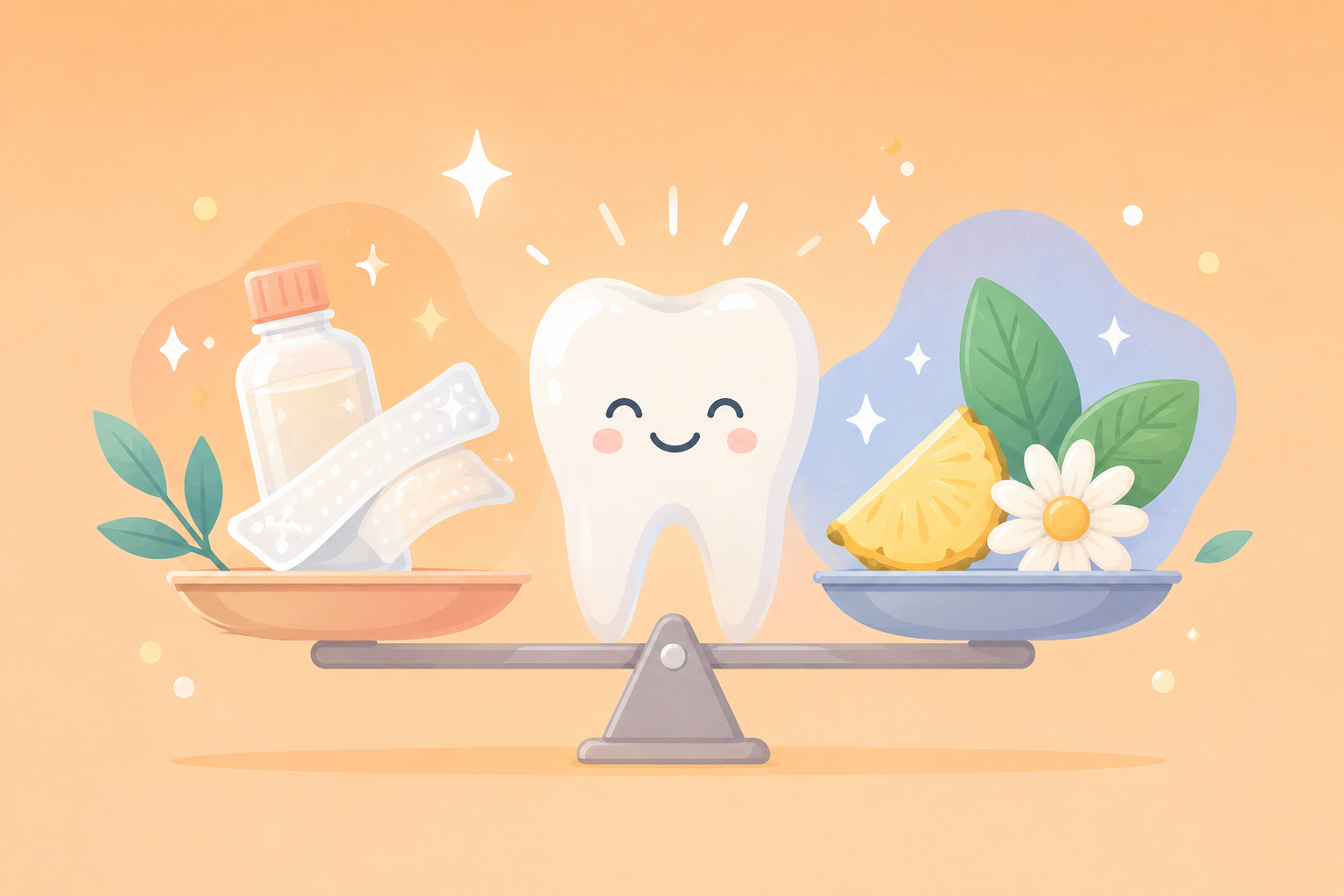
White turmeric should not be treated as a “natural whitening miracle.” Research on Curcuma zedoaria has explored properties such as antimicrobial activity, but that is not the same as proving it independently bleaches human teeth. The American Dental Association also notes that reliable evidence does not support regular turmeric as a natural tooth-whitening method.
The better question is not, “Can one botanical do everything?”
It is: how does that ingredient fit into the complete whitening system?

TL;DR
White turmeric can play a supportive role in oral care, but it is not a proven stand-alone bleaching ingredient. For deeper tooth whitening, hydrogen peroxide has the stronger evidence and provides the main bleaching action. A better way to judge whitening strips is to look at the full formula, including surface-stain support, enamel-supportive ingredients, peroxide exposure, wear time, and correct use.
What Is White Turmeric in Oral Care, and Does It Whiten Teeth?
White turmeric, often referring to Curcuma zedoaria, is a plant in the ginger family. Existing studies have explored biological properties of its extracts, but strong human clinical evidence showing that white turmeric alone bleaches teeth is lacking. It is more accurate to describe it as a complementary oral-care ingredient than a stand-alone whitening active.
That distinction keeps the claim aligned with the evidence.
Laboratory research has found antimicrobial activity in extracts of Curcuma zedoaria. Separate preclinical research has examined anti-inflammatory effects of the rhizome extract.
Neither study tested tooth bleaching in people. Broader botanical findings should not be turned into whitening claims the research never made.
The same caution applies to DIY advice. The ADA says there is no reliable scientific evidence that turmeric itself whitens teeth.
White turmeric can still make sense in a formula. It just should not be asked to do every job.
White Turmeric in Oral Care Works Best as Part of a Complete Formula
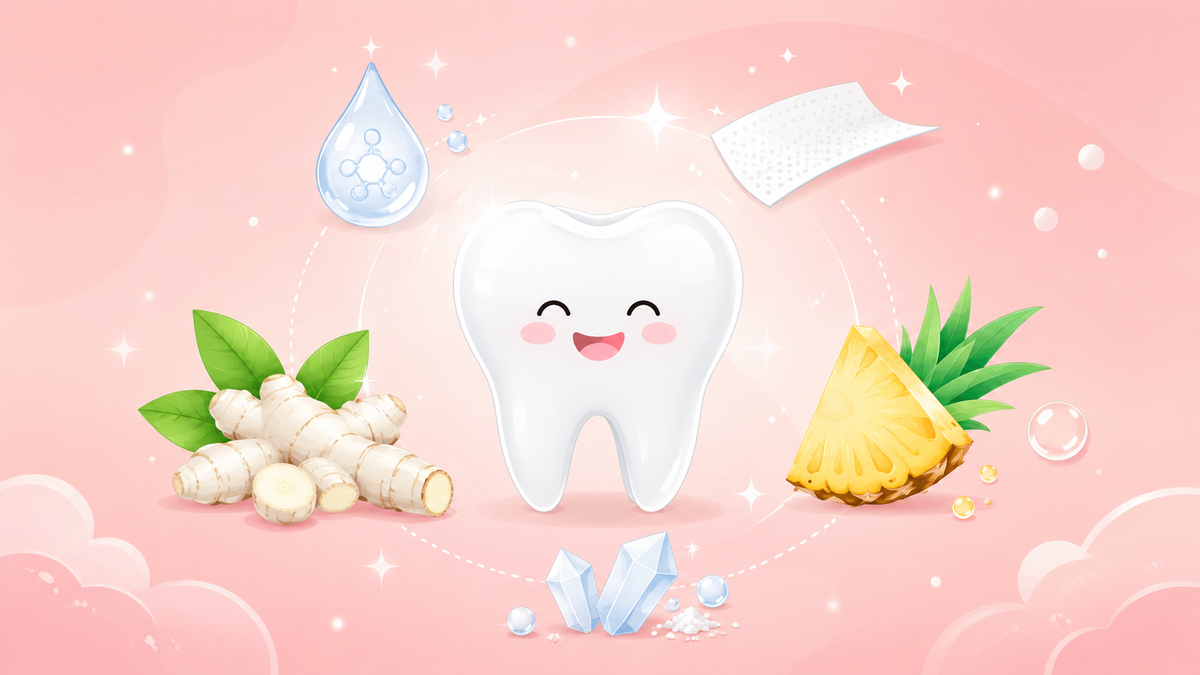
The current SAINT Whitening Strips ingredient list includes coconut oil, deionized water, cellulose gum, carbomer, nano-hydroxyapatite, bromelain, hydrogen peroxide, white turmeric, Dead Sea salt, and xylitol.
Looking at that list as one system is more useful than choosing a single “hero ingredient.”
Hydrogen peroxide handles the main bleaching work. Bromelain has research behind surface-stain removal. Nano-hydroxyapatite is included for enamel-focused support. White turmeric complements those ingredients rather than replacing them.
The delivery ingredients matter too. The FDA lists carboxymethyl cellulose, a form of cellulose gum, as a formulation aid, stabilizer, thickener, and texturizer.
This is why gentler whitening strips should be evaluated as complete formulas, not by one trendy ingredient.
What Actually Does the Bleaching in Whitening Strips?

Hydrogen peroxide provides the primary deeper bleaching action in peroxide-based whitening strips. It can move through dental hard tissues and create reactive oxygen molecules that interact with colored compounds inside enamel and dentin. White turmeric does not have the same established bleaching mechanism and should not be presented as a peroxide replacement.
The American Dental Association explains that hydrogen peroxide and carbamide peroxide are common bleaching ingredients. It also separates extrinsic stains on the tooth surface from intrinsic discoloration within the tooth.
That explains why “whitening” can mean different things. Surface cleaning can reduce external stains, while peroxide works through chemical oxidation and can change deeper tooth color.
A 2026 randomized controlled trial of 70 adults found that 3% hydrogen peroxide whitening strips produced better whitening than placebo strips. Effective whitening does not automatically require chasing the highest peroxide number available.
Our guide to how much peroxide is too much explains why concentration must be considered with contact time, frequency, gum exposure, and application.
How SAINT's Whitening Formula Splits the Jobs
The easiest way to read an ingredient list is to ask what each ingredient is there to do.
| Ingredient | Main Role in the Formula | What the Evidence Supports |
|---|---|---|
| Hydrogen peroxide | Primary active whitening ingredient | The ADA describes hydrogen peroxide as a common bleaching agent that oxidizes colored compounds within dental tissues. |
| Bromelain | Surface-stain support | A clinical trial found that a toothpaste using papain and bromelain was effective at removing extrinsic stains. |
| Nano-hydroxyapatite | Enamel and mineral support | A 2024 systematic review and meta-analysis evaluated nano-hydroxyapatite for remineralization of white spot lesions. |
| White turmeric | Complementary botanical ingredient | Curcuma zedoaria extracts have shown antimicrobial activity in laboratory research, but strong clinical evidence for stand-alone tooth bleaching is lacking. |
| Xylitol | Supporting oral-care ingredient | A 2025 systematic review found xylitol chewing gum reduced mutans streptococci in many included comparisons, although results varied by outcome and delivery method. |
| Coconut oil | Complementary ingredient | Coconut oil should not be treated as the bleaching active. The ADA notes there is no reliable evidence that oil pulling whitens teeth. |
| Dead Sea salt | Supporting component | It is part of the current SAINT Whitening Strips formula, but it should not be credited with peroxide's deeper bleaching action. |
| Deionized water, cellulose gum, carbomer | Gel base and delivery support | These ingredients help form the physical gel system. The FDA identifies cellulose gum derivatives as formulation aids, stabilizers, thickeners, and texturizers. |
Bromelain does not need to act like peroxide to be useful. Nano-hydroxyapatite does not need to be a bleach to support enamel. White turmeric does not need a miracle claim to have a place in the formula.
You can learn more about how nano-hydroxyapatite supports enamel.
Why Do Peroxide Concentration, Contact Time, and Frequency Matter?
Effective peroxide whitening depends on the full exposure protocol, not simply whether peroxide appears on the label. Concentration matters, but so do wear time, treatment frequency, product fit, gum exposure, and individual sensitivity. A well-designed lower-concentration system can still whiten effectively, so “stronger” does not automatically mean “better.”
A 2025 systematic review included 81 at-home bleaching studies, with 53 in its network meta-analysis. Researchers found no statistically significant differences in most concentration comparisons except some of the highest versus lowest concentrations. The certainty of the evidence was low.
Concentration still matters. The ADA identifies tooth sensitivity and gingival irritation as common adverse effects of vital tooth whitening.
Wear time matters too. Current SAINT Whitening Strips directions call for 30 minutes of wear, followed by removal and rinsing with water.
That 30-minute window is part of the product design. Leaving strips on longer does not automatically mean better results.
A 2026 systematic review found small, statistically detectable enamel microhardness changes without clear evidence of clinically meaningful effects. The authors concluded that peroxide bleaching appears unlikely to cause clinically meaningful enamel harm when used according to recommended protocols, while noting limits in the available evidence.
Surface Stains, Deeper Discoloration, and Enamel Support Need Different Tools

Surface stains, deeper discoloration, and enamel support are different problems. Enzymes and cleaning systems can help with extrinsic stains, peroxide provides chemical bleaching for deeper color change, and nano-hydroxyapatite supports enamel mineral care. A balanced formula can address several goals without pretending every ingredient does the same thing.
The ADA explains that extrinsic stains collect on the enamel surface, while intrinsic discoloration occurs within the tooth.
A clinical study found that an enzymatic toothpaste with papain and bromelain performed well for extrinsic stain removal. Peroxide has a different role because its whitening effect comes from oxidation.
Nano-hydroxyapatite adds another layer. A systematic review found preliminary clinical evidence that hydroxyapatite-containing oral-care products can improve tooth brightness, while research also supports its use in remineralization.
We explain those differences further in hydroxyapatite and whitening and remineralization versus whitening.
How Should You Evaluate a Whitening Formula?
Do not judge a whitening product by one botanical or the highest peroxide percentage on the shelf. Look at what produces the deeper color change, what supports surface-stain management, whether the formula includes enamel-focused ingredients, and how the product controls contact time and use.
Ask a few simple questions:
- What ingredient is doing the actual bleaching?
- Does the formula also address surface stains?
- Is there an enamel-supportive component?
- Are botanical ingredients described realistically?
- Are the wear-time instructions clear?
- Does the complete formula make sense together?
That is the lens behind SAINT Whitening Strips. Hydrogen peroxide provides active whitening, while nano-hydroxyapatite, bromelain, white turmeric, coconut oil, Dead Sea salt, and xylitol are combined within the broader formula.
White turmeric can be part of a thoughtful whitening system. It just should not have to pretend to be the whole system.
Conclusion
White turmeric in oral care is a good example of why ingredient claims need context.
There is not strong clinical evidence that white turmeric alone acts as a powerful tooth bleach. Hydrogen peroxide has the established role in deeper chemical whitening. Bromelain can support surface-stain removal, while nano-hydroxyapatite brings an enamel-focused role.
When you compare whitening products, look beyond the ingredient that gets the biggest font on the package. Check the full formula, the bleaching active, wear time, frequency, enamel support, and correct-use instructions.
If that balanced approach fits your goals, explore SAINT Whitening Strips, which combine peroxide whitening with complementary enamel and surface-supportive ingredients.
Frequently Asked Questions
1. Does white turmeric actually whiten teeth?
There is not strong human clinical evidence showing that white turmeric by itself bleaches teeth. The ADA says there is no reliable evidence supporting turmeric as a DIY whitening method. It is more accurate to treat white turmeric as a supportive ingredient within a complete formula.
2. Is white turmeric the same as regular yellow turmeric?
Not exactly. White turmeric commonly refers to Curcuma zedoaria, while familiar culinary turmeric is generally Curcuma longa. Research on Curcuma zedoaria should not automatically be treated as evidence about every turmeric species or every oral-care use.
3. What ingredient in whitening strips actually bleaches teeth?
In peroxide-based strips, hydrogen peroxide is the main bleaching active. The ADA explains that peroxide whitening oxidizes colored compounds within dental tissues, which is different from simply removing surface stains.
4. Is white turmeric better than hydrogen peroxide for teeth whitening?
There is no good evidence showing white turmeric is a better bleaching agent than hydrogen peroxide. Peroxide has established clinical evidence, including a 2026 randomized trial where 3% hydrogen peroxide strips outperformed placebo.
5. Why combine white turmeric, peroxide, bromelain, and nano-hydroxyapatite?
They can serve different roles. Peroxide provides deeper bleaching, bromelain has evidence for surface-stain removal, nano-hydroxyapatite has been studied for enamel remineralization, and white turmeric works as a complementary botanical. The value comes from the full formulation rather than expecting one ingredient to do everything.