
Rod vs. Needle-Shaped Nano-Hydroxyapatite: Which Is Better for Your Teeth?
If you've been exploring fluoride-free toothpaste options, you've probably come across nano-hydroxyapatite (n-HA), the same calcium-phosphate mineral your enamel is naturally made of. But here's what most brands don't tell you: not all nano-hydroxyapatite is created equal. The shape of the particle matters more than you might think.
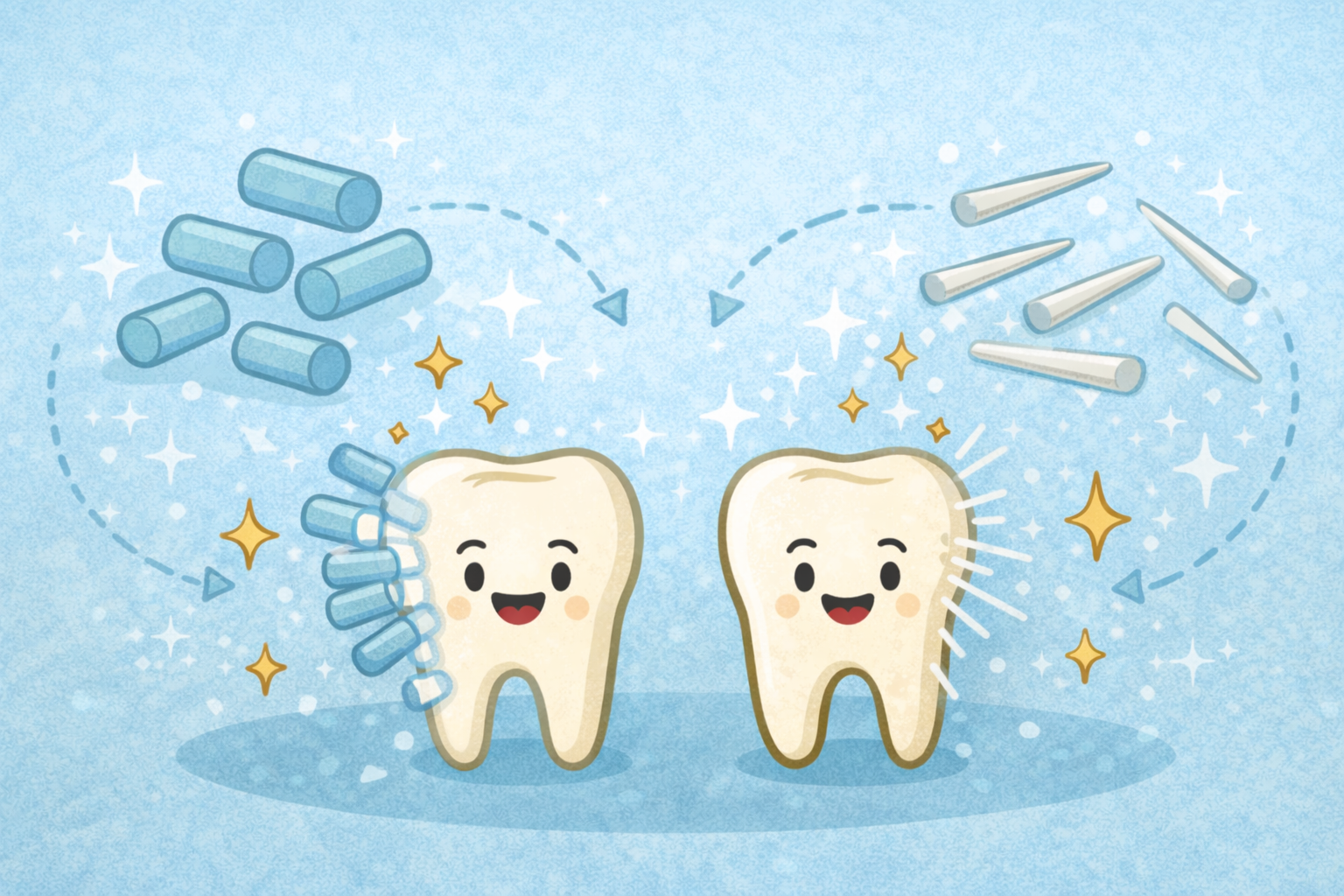
The two most common forms are rod-shaped and needle-shaped n-HA particles. Rod-shaped particles are widely considered the safer, more biocompatible option because their geometry closely mirrors the natural crystalline structure found in human enamel and dentin, allowing them to integrate with tooth surfaces in a way that feels familiar to the body. Needle-shaped particles, by contrast, have raised concerns in the research community. Their sharp geometry has been associated in some studies with a higher potential for cytotoxicity and unintended cellular penetration, which is a meaningful consideration for something applied to your oral tissues every day.
Shape aside, formulation context matters just as much. The most rigorously developed n-HA toothpastes tend to share a few things in common: they're dentist-formulated, free of harsh surfactants like SLS, free of endocrine-disrupting ingredients like parabens and triclosan, and designed with the oral microbiome in mind, not just surface whitening. A high pH, around 9, further supports an environment where remineralization can thrive.
This guide breaks down what separates rod-shaped from needle-shaped n-HA, what the research shows, and what to look for when choosing a toothpaste that actually works with your enamel, not just on it.
What Is Nano-Hydroxyapat ite?
ite?
Nano-hydroxyapatite is a bioidentical mineral, structurally identical to the hydroxyapatite crystals that make up roughly 97% of your tooth enamel. At the nanoscale, thousands of times thinner than a human hair, these particles can bind directly to enamel surfaces and support the tooth's natural repair process.
Studies in peer-reviewed dental journals have shown n-HA can:
• Remineralize enamel by replenishing minerals lost from daily acid exposure
• Reduce sensitivity by sealing exposed microscopic openings in enamel
• Smooth the enamel surface by filling irregularities for a naturally brighter look
• Support long-term enamel health without bleaching agents or harsh abrasives
Rod-Shaped Nano-Hydroxyapatite
 Rod-shaped nano-hydroxyapatite is considered the gold standard form of n-HA in dentist-developed formulas, and for good reason. Its geometry closely mirrors the natural crystalline structure of human enamel, which is itself composed of tightly packed mineral rods laid down by the body during tooth development.
Well-formulated products use rod-shaped n-HA particles sized around 20 to 80 nanometers, closely matching the scale of natural enamel crystals. This allows the particles to bind effectively to the tooth surface, fill microscopic areas of mineral loss, and reinforce enamel over time, all while maintaining an excellent safety profile backed by extensive clinical research.
Key Benefits of Rod-Shaped n-HA:
-
Closest structural match to natural enamel: The rod formation mirrors how enamel crystals grow, supporting seamless surface integration rather than forcing a foreign structure onto the tooth.
-
Smooth, even surface layering: Particles coat enamel uniformly, improving light reflection and contributing to a naturally brighter appearance without abrasives.
-
Gentle, sustained reinforcement: Works in harmony with existing enamel rather than aggressively altering the surface, which is important for long-term enamel health.
-
Strongest safety profile of any n-HA form: The most extensively studied particle shape for daily oral care use, with a well-documented record across multiple clinical settings.
-
Microbiome-compatible: Because rod-shaped particles integrate gently at the surface level, they are less likely to disrupt the delicate balance of the oral microbiome, a growing priority in modern dental formulation.
Needle-Shaped Nano-Hydroxyapatite

Needle-shaped n-HA has a thinner, more elongated structure than its rod-shaped counterpart. While some manufacturers use this form for its ability to reach into small enamel pores, this same sharp geometry has drawn scrutiny from researchers.
Unlike rod-shaped particles, which mimic the body's own mineral architecture, needle-shaped particles introduce a structure not naturally found in enamel. Several in vitro studies have raised questions about the cytotoxic potential of needle-shaped nanoparticles at the cellular level, particularly due to their sharp tips and higher surface-area-to-volume ratio, which increases reactivity. While needle-shaped n-HA is present in some over-the-counter products, it is less commonly chosen by dentist-formulated brands where biocompatibility is a primary concern.
Considerations for Needle-Shaped n-HA:
-
Penetrates enamel micropores: The slim structure can reach small surface openings, but this same penetrating quality raises questions about interaction with soft tissue at the gumline.
-
Higher cytotoxic potential: Research suggests the sharp geometry of needle-shaped particles may pose greater risk of cellular irritation compared to rod-shaped alternatives.
-
Less biomimetic: The elongated shape does not reflect the natural crystalline structure of enamel, meaning integration with the tooth surface is less physiologically aligned.
-
Less studied for long-term daily use: Compared to rod-shaped n-HA, the long-term safety data for needle-shaped particles in daily oral care applications is less comprehensive.
Rod vs Needle Nano-Hydroxyapatite: Side-by-Side
-
Particle structure: Rod-shaped n-HA is short and thick, which closely mirrors natural enamel crystals. Needle-shaped n-HA is thinner and more elongated, a structure not naturally found in enamel.
-
Biomimetic match: Rod-shaped n-HA has a high biomimetic match because it closely resembles the body's own mineral rods. Needle-shaped n-HA has a lower biomimetic match because its structure is less aligned with natural enamel architecture.
- Surface interaction: Rod-shaped n-HA tends to layer smoothly and evenly onto enamel. Needle-shaped n-HA is more likely to penetrate micropores and has higher surface reactivity.
-
Safety profile: Rod-shaped n-HA has been more extensively studied and has a stronger clinical track record. Needle-shaped n-HA has raised some cytotoxicity concerns in parts of the research literature.
-
Microbiome compatibility: Rod-shaped n-HA is often favored in microbiome-conscious formulations. Needle-shaped n-HA is less studied in this context.
- Use in dentist-formulated brands: Rod-shaped n-HA is more widely used in professionally developed formulas, while needle-shaped n-HA is less common in clinically guided formulations.
The takeaway: When it comes to nano-hydroxyapatite, shape is not a minor technical detail. It reflects a fundamental formulation philosophy. Rod-shaped n-HA is chosen by dentist-developed brands because it works with the body's natural enamel structure, offering proven remineralization, a clean safety record, and compatibility with the oral microbiome. Needle-shaped n-HA may reach into smaller surface areas, but its less biomimetic geometry and emerging safety questions make it a less compelling choice for a product used twice daily, every day. For long-term enamel health, the closer a formula mirrors nature, the better.
What Nano-Hydroxyapatite Does for Your Teeth Every Day
 Remineralizes Enamel
Acidic foods and drinks cause small mineral losses from enamel throughout the day. Nano-hydroxyapatite, particularly in its rod-shaped form, which mirrors the body's own enamel crystals, helps restore those minerals through a process called remineralization. The result is enamel that becomes more resilient over time, before minor damage has a chance to become visible.
Creates a Naturally Brighter Appearance
Unlike peroxide-based whitening systems, n-HA doesn't bleach teeth. Instead, it smooths and fills the enamel surface so it reflects light more evenly. Rod-shaped particles are especially effective here because their uniform geometry enables more consistent surface layering, producing a natural, healthy-looking brightness rather than the artificial stark white associated with chemical bleaching.
Reduces Sensitivity
When enamel thins or becomes porous, the dentin layer underneath, which is connected to nerve endings, becomes more exposed. Nano-hydroxyapatite helps seal these microscopic openings, reducing sharp sensitivity to cold drinks, hot food, or sweet snacks. Because rod-shaped n-HA integrates gently at the surface level without the sharp geometry of needle-shaped alternatives, this sealing effect happens without unnecessary disruption to surrounding soft tissue.
Builds Long-Term Enamel Strength
With consistent daily use, n-HA gradually builds up a protective mineral layer. This isn't a one-time fix. It's cumulative, with most people noticing meaningful improvements in 4 to 8 weeks. The key is choosing a formula stable enough for twice-daily use, free of harsh surfactants like SLS, formulated at a pH that supports remineralization, and built around ingredients that work with the oral environment rather than against it.
How to Choose a Nano-Hydroxyapatite Product That Works
Particle shape is just one factor. When evaluating an n-HA toothpaste, here's what actually drives results:
• High-purity n-HA: Particle quality directly affects how effectively it binds to enamel
• Consistent particle sizing: Particles that are too large can't interact with enamel at the right level
• Complementary ingredients: Look for xylitol for microbiome balance, aloe vera for gum support, and natural oils for freshness
• No harsh abrasives: Highly abrasive formulas can counteract remineralization benefits
SAINT Mint Toothpaste pairs nano-hydroxyapatite with aloe vera, coconut oil, and cold-pressed spearmint, plant-based ingredients chosen to complement n-HA's enamel-supportive properties while keeping the formula gentle and balanced.
Building a Daily Routine Around Nano-Hydroxyapatite
For best results, n-HA works as part of a consistent routine:
• Brush twice daily, morning and night, with a soft-bristled toothbrush to protect enamel while allowing minerals to interact with the surface
• Floss once daily to remove plaque between teeth where brushing can't reach
• Use a tongue scraper to reduce odor-causing bacteria and support overall oral freshness
• Be consistent because remineralization is gradual, and results compound over weeks, not days
FAQs
1. What is nano-hydroxyapatite?
Nano-hydroxyapatite is a bioidentical calcium-phosphate mineral that mirrors the natural structure of tooth enamel. Used in oral care products, it supports remineralization, reduces sensitivity, and promotes a naturally brighter appearance without bleaching agents or harsh chemicals.
2. What is the difference between rod and needle-shaped nano-hydroxyapatite?
Rod-shaped particles closely resemble the crystalline structure of natural enamel, allowing them to integrate smoothly and evenly along the tooth surface. Needle-shaped particles are thinner and more elongated, a geometry not naturally found in enamel, and have raised questions in research literature regarding cytotoxic potential due to their sharp profile and higher surface reactivity. For daily oral care, the structural similarity of rod-shaped n-HA to the body's own mineral architecture makes it the more biomimetically appropriate choice.
3. Is one shape of nano-hydroxyapatite better than the other?
For everyday use, rod-shaped n-HA is generally the preferred form among dentist-formulated products. Its geometry mirrors natural enamel crystals, it has the most extensive clinical safety record of any n-HA particle shape, and it's better suited to the microbiome-conscious formulations that define modern, non-toxic oral care. Needle-shaped particles introduce a structure foreign to enamel and carry emerging safety questions that make them a less compelling choice for a product used twice daily.
4. Can nano-hydroxyapatite help with sensitive teeth?
Yes. By sealing microscopic openings in enamel, n-HA meaningfully reduces sensitivity to hot, cold, and sweet stimuli, particularly with consistent use over several weeks. Rod-shaped particles are especially well-suited for this, as their smooth surface integration minimizes irritation to surrounding soft tissue while effectively closing vulnerable enamel zones.
5. Does nano-hydroxyapatite whiten teeth?
It doesn't bleach like peroxide-based products. Instead, n-HA smooths and restores the enamel surface so it reflects light more evenly, producing a naturally brighter appearance over time. This makes it a particularly good fit for people seeking visible results without the sensitivity or chemical exposure associated with traditional whitening systems.
6. Is nano-hydroxyapatite safe for daily use?
Yes, and rod-shaped n-HA in particular has one of the strongest safety profiles in modern oral care. It has been studied extensively for decades and has been a dental standard in Japan since the 1980s. When formulated without SLS, parabens, triclosan, or other potentially irritating ingredients, n-HA toothpaste is considered safe for regular use by both adults and children.
,%20the%20same%20calcium-phosphate%20mineral%20your%20enamel%20is%20naturally%20made%20of.%20But%20here's%20...)